Unity Helpers
Treasure chest of Unity developer tools. Professional inspector tooling, high-performance utilities, spatial queries, and 20+ editor tools.
Wallstop Studios Unity Helpers - Editor Tools Guide
TL;DR — What You Get
- One‑click utilities for sprites, textures, validation, and automation.
- Clear menus, step‑by‑step workflows, and safe previews before destructive actions.
- Start with: Sprite Cropper, Image Blur, Animation Creator, Prefab Checker, and the ScriptableObject Singleton Creator.
Comprehensive documentation for all editor wizards, windows, and automation tools.
What Do You Want To Do? (Task-Based Index)
Optimize Sprite Memory & Performance
- Remove transparent padding → Sprite Cropper
- Adjust texture size automatically → Fit Texture Size
- Batch apply import settings → Texture Settings Applier
- Standardize sprite settings → Sprite Settings Applier
- Adjust sprite pivots → Sprite Pivot Adjuster
Create & Edit Animations
- Edit animation timing/frames visually → Sprite Animation Editor
- Bulk-create animations from sprites → Animation Creator
- Convert sprite sheets to clips → Sprite Sheet Animation Creator
- Add/edit animation events → Animation Event Editor
- Copy/sync animations between folders → Animation Copier
Build Sprite Atlases
- Create atlases with regex/labels → Sprite Atlas Generator
Validate & Fix Prefabs
- Check prefabs for errors → Prefab Checker
Analyze Code Quality
- Detect inheritance and Unity method issues → Unity Method Analyzer
Apply Visual Effects
- Blur textures (backgrounds, DOF) → Image Blur Tool
- Resize textures with filtering → Texture Resizer
Automate Setup & Maintenance
- Auto-create singleton assets → ScriptableObject Singleton Creator
- Respond to asset changes → Asset Change Detection
- Cache attribute metadata → Attribute Metadata Cache Generator
- Track sprite labels → Sprite Label Processor
- Manually trigger script recompilation → Request Script Recompilation
- Configure buffer settings → Project Settings: Unity Helpers
Enhance Inspector Workflows
See the Inspector Attributes documentation for:
[WInLineEditor]— Embed nested object inspectors inline[WShowIf]— Conditional field visibility[WEnumToggleButtons]— Visual toggle buttons for enums[WValueDropDown],[IntDropDown],[StringInList]— Selection dropdowns[WReadOnly],[WNotNull]— Validation attributes[WGroup],[WButton]— Layout and method invocation
Table of Contents
- Texture & Sprite Tools
- Animation Tools
- Sprite Atlas Tools
- Validation & Quality Tools
- Custom Component Editors
- Property Drawers & Attributes
- Automation & Utilities
- Quick Reference
Texture & Sprite Tools
Image Blur Tool
Menu: Tools > Wallstop Studios > Unity Helpers > Image Blur
Purpose: Apply Gaussian blur effects to textures in batch for backgrounds, depth-of-field, or softened sprites.
Key Features:
- Configurable blur radius (1-200 pixels)
- Batch processing support
- Drag-and-drop folders/files
- Preserves original files
- Parallel processing for speed
Common Workflow:
1. Open Image Blur Tool
2. Drag sprite folder into designated area
3. Set blur radius (e.g., 10 for subtle, 50 for heavy)
4. Click "Apply Blur"
5. Find blurred versions with "_blurred_[radius]" suffix
Best For:
- UI background blur effects
- Depth-of-field texture generation
- Post-processing texture preparation
Visual Demo
Adjusting blur radius from 0 to 200 pixels on a UI background texture

Sprite Cropper
Menu: Tools > Wallstop Studios > Unity Helpers > Sprite Cropper
Purpose: Automatically remove transparent padding from sprites to optimize memory and atlas packing.
Key Features:
- Alpha threshold detection (0.01)
- Configurable padding preservation
- Batch directory processing
- “Only Necessary” mode to skip optimal sprites
- Pivot point preservation in normalized coordinates
Common Workflow:
1. Open Sprite Cropper
2. Add sprite directories to "Input Directories"
3. Set padding (e.g., 2px on all sides for outlines)
4. Enable "Only Necessary" to skip already-cropped sprites
5. Click "Find Sprites To Process" to preview
6. Click "Process X Sprites"
7. Replace originals with "Cropped_*" versions

**Danger Zone — Reference Replacement:**
- After cropping into `Cropped_*` outputs, you can optionally replace references to original sprites across assets with their cropped counterparts. This is powerful but destructive; review the preview output and ensure you have version control backups before applying.
Best For:
- Sprites exported with excessive padding
- Character animation optimization
- Sprite atlas memory reduction
- Preparing assets for efficient packing
Performance Impact: Can reduce texture memory by 30-70% on padded sprites.
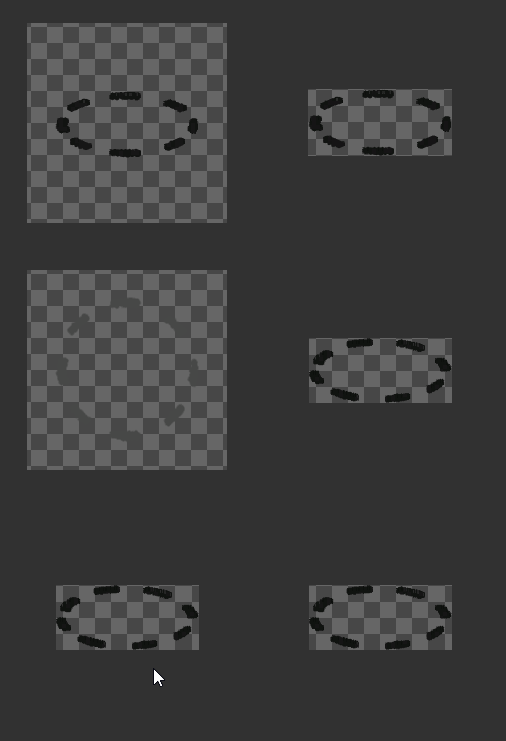
Visual Demo
Before and after: transparent padding removed while preserving sprite content and pivot
Related Tools:
- After cropping, use Texture Settings Applier to batch apply import settings
- Before creating atlases, run Sprite Cropper → Sprite Atlas Generator
- Use Sprite Pivot Adjuster after cropping to fix pivot points
Texture Settings Applier
Menu: Tools > Wallstop Studios > Unity Helpers > Texture Settings Applier
Purpose: Batch apply standardized texture import settings across multiple assets.
Configurable Settings:
- Read/Write enabled
- Mipmap generation
- Wrap Mode (Clamp/Repeat/Mirror)
- Filter Mode (Point/Bilinear/Trilinear)
- Compression (CompressedHQ/LQ/Uncompressed)
- Crunch compression
- Max texture size (32-8192)
- Texture format
Common Configurations:
UI Sprites (Pixel-Perfect):
Filter Mode: Point
Wrap Mode: Clamp
Compression: CompressedHQ or None
Generate Mip Maps: false
Max Size: 2048 or match source
Environment Textures:
Filter Mode: Trilinear
Wrap Mode: Repeat
Compression: CompressedHQ
Generate Mip Maps: true
Crunch Compression: true
Character Sprites:
Filter Mode: Bilinear
Wrap Mode: Clamp
Compression: CompressedHQ
Generate Mip Maps: false
Workflow:
1. Open Texture Settings Applier
2. Configure desired settings with checkboxes
3. Add textures individually OR add directories
4. Click "Set" to apply
5. Unity reimports affected textures
Best For:
- Standardizing settings after art imports
- Fixing texture quality issues across directories
- Maintaining performance standards
- Team consistency enforcement
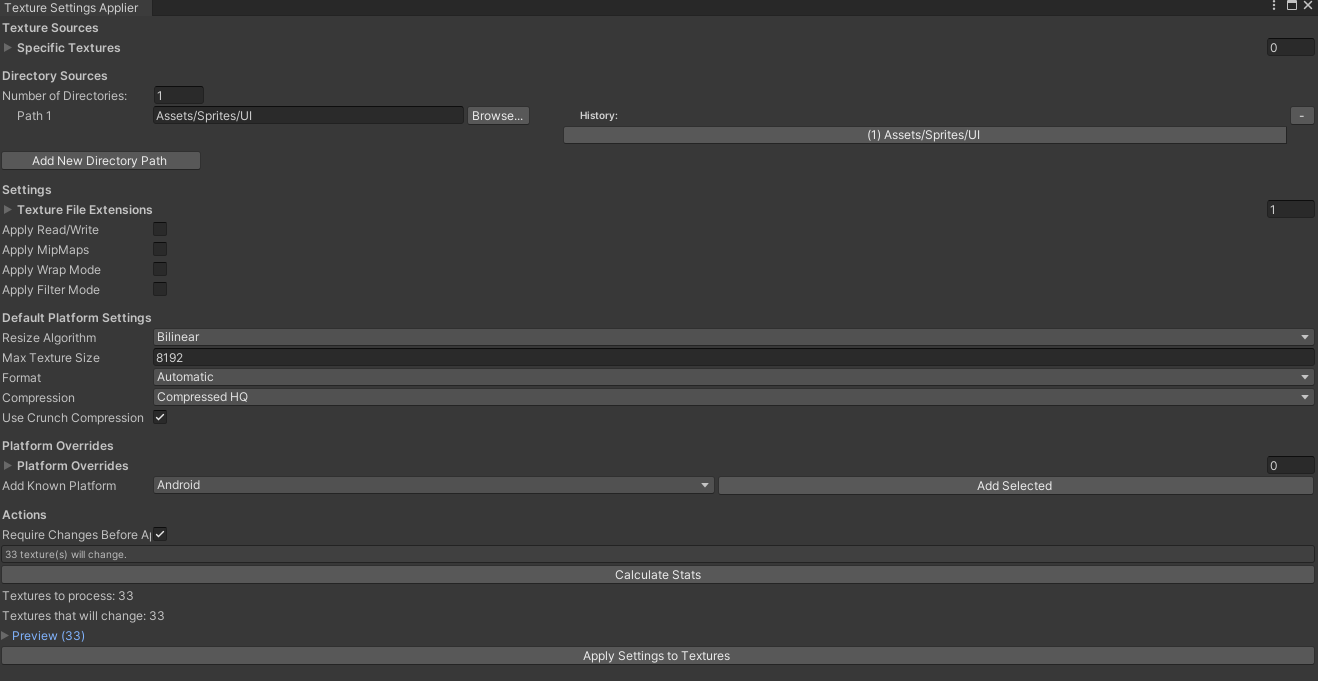
Visual Reference
Texture Settings Applier with filter mode, wrap mode, and compression options
Related Tools:
- After setting texture settings, use Sprite Settings Applier for sprite-specific options
- Use Sprite Cropper first to optimize memory before applying settings
- Combine with Fit Texture Size to auto-adjust max texture sizes
Sprite Pivot Adjuster
Menu: Tools > Wallstop Studios > Unity Helpers > Sprite Pivot Adjuster
Purpose: Compute and apply alpha‑weighted center‑of‑mass pivots in bulk. Produces perceptually centered pivots (ignoring near‑transparent pixels) and speeds re‑imports by skipping unchanged results.
Key Features:
- Alpha‑weighted center‑of‑mass pivot (configurable cutoff)
- Optional sprite name regex filter
- Skip unchanged (fuzzy threshold) and Force Reimport
- Directory picker with recursive processing
Workflow:
1) Open Sprite Pivot Adjuster
2) Add one or more directories
3) (Optional) Set Sprite Name Regex to filter
4) Adjust Alpha Cutoff (e.g., 0.01 to ignore fringe pixels)
5) Enable “Skip Unchanged” to reimport only when pivot changes
6) (Optional) Enable “Force Reimport” to override skip
7) Run the adjuster to write importer pivot values
Best For:
- Ground‑aligning characters while keeping lateral centering
- Consistent pivots across varied silhouettes
- Normalizing pivots before animation creation
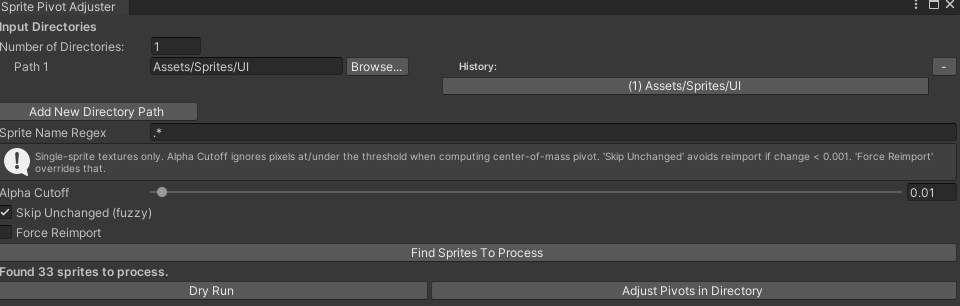
Visual Reference
Sprite Pivot Adjuster with alpha cutoff slider and directory selection
Sprite Settings Applier
Menu: Tools > Wallstop Studios > Unity Helpers > Sprite Settings Applier
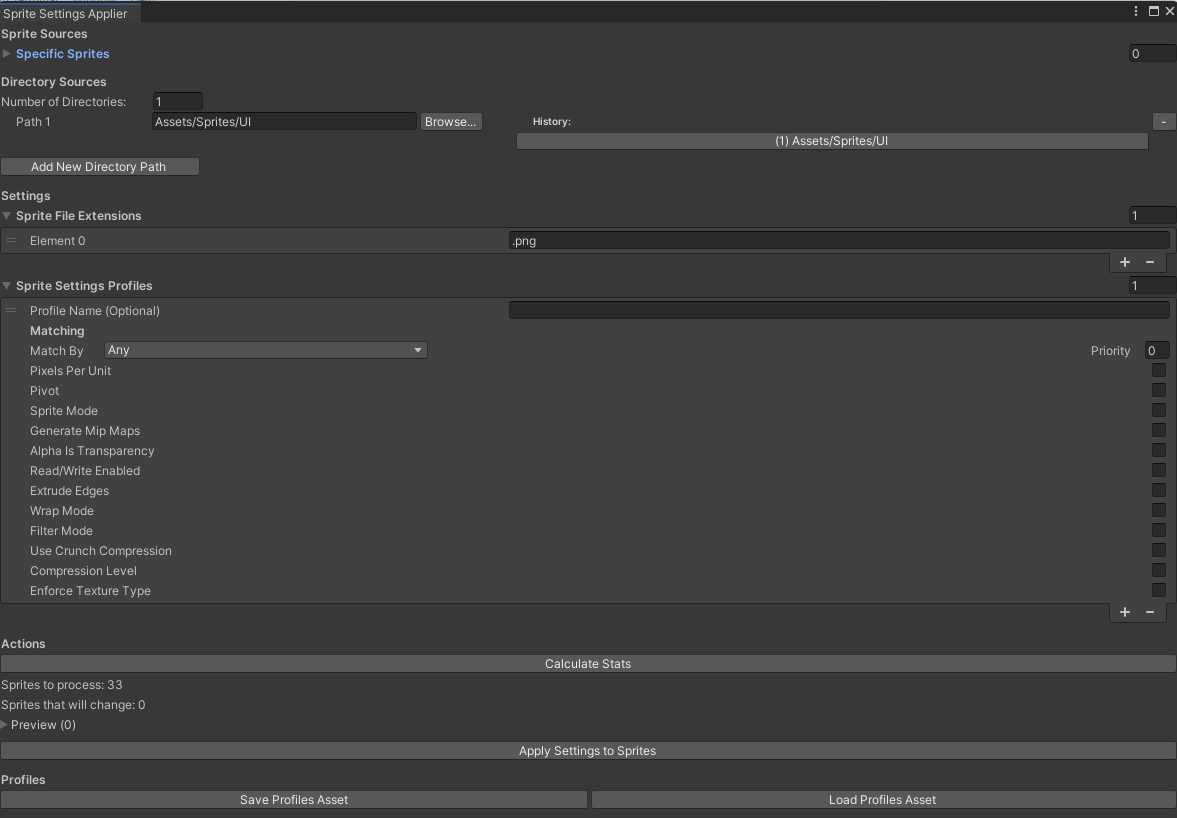
Purpose: Apply sprite‑specific importer settings in bulk, driven by matchable “profiles” (Any/NameContains/PathContains/Regex/Extension) with priorities. Great for standardizing PPU, pivots, modes, and compression rules across large folders.
Profiles & Matching:
- Create a
SpriteSettingsProfileCollectionScriptableObject - Add one or more profiles (with priority) and choose a match mode:
- Any, NameContains, PathContains, Extension, Regex
- Higher priority wins when multiple profiles match
Key Settings (per profile):
- Pixels Per Unit, Pivot, Sprite Mode
- Generate Mip Maps, Read/Write, Alpha is Transparency
- Extrude Edges, Wrap Mode, Filter Mode
- Compression Level and Crunch Compression
- Texture Type override (ensure Sprite)
Workflow:
1) Create a SpriteSettingsProfileCollection (Assets > Create > … if available) or configure profiles in the window
2) Open Sprite Settings Applier
3) Add directories and/or explicit sprites
4) Choose which profile(s) to apply and click Set
5) Unity reimports affected sprites
Best For:
- Enforcing project‑wide sprite import standards
- Fixing inconsistent PPU/pivots automatically
- Applying different settings per folder/pattern (via Regex/Path)
Visual Reference
Sprite Settings Applier with profile matching modes and import settings
Texture Resizer
Menu: Tools > Wallstop Studios > Unity Helpers > Texture Resizer
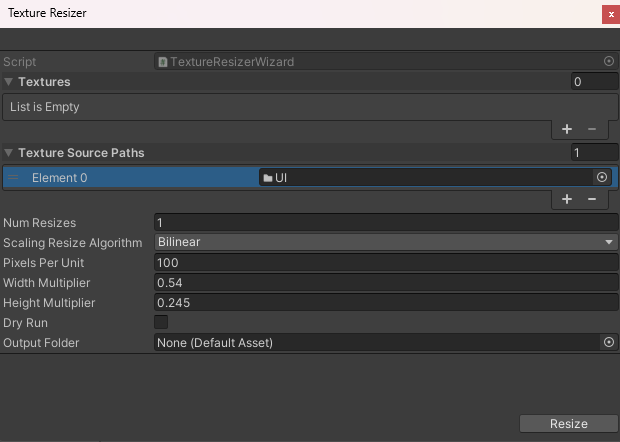
Purpose: Batch resize textures using bilinear or point filtering algorithms with configurable scaling multipliers.
Configuration Options:
- textures: Manually selected textures to resize
- textureSourcePaths: Drag folders to process all textures within
- numResizes: Number of resize iterations to apply
- scalingResizeAlgorithm: Bilinear (smooth) or Point (pixel-perfect)
- pixelsPerUnit: Base PPU for scaling calculations
- widthMultiplier: Width scaling factor (default: 0.54)
- heightMultiplier: Height scaling factor (default: 0.245)
How It Works:
- For each texture, calculates:
extraWidth = width / (PPU * widthMultiplier) - Resizes to
newSize = (width + extraWidth, height + extraHeight) - Repeats for
numResizesiterations - Overwrites original PNG files
Workflow:
1. Open Texture Resizer wizard
2. Add textures manually OR drag texture folders
3. Set algorithm (Bilinear for smooth, Point for pixel art)
4. Configure PPU and multipliers
5. Set number of resize passes
6. Click "Resize" to apply
Resize Algorithms:
Bilinear:
- Smooth interpolation
- Good for photographic/realistic textures
- Prevents harsh edges
- Slight blur on upscaling
Point:
- Nearest-neighbor sampling
- Perfect for pixel art
- Maintains sharp edges
- No interpolation blur
Best For:
- Batch upscaling sprites
- Standardizing texture dimensions
- Preparing assets for specific PPU
- Pixel art scaling (use Point)
- Multiple resize passes for gradual scaling
Important Notes:
- Destructive operation: Overwrites original files
- Textures are made readable automatically
- Changes are permanent (backup originals!)
- AssetDatabase refreshes after completion
Visual Reference
Texture Resizer with bilinear/point algorithm selection and multiplier settings
Fit Texture Size
Menu: Tools > Wallstop Studios > Unity Helpers > Fit Texture Size
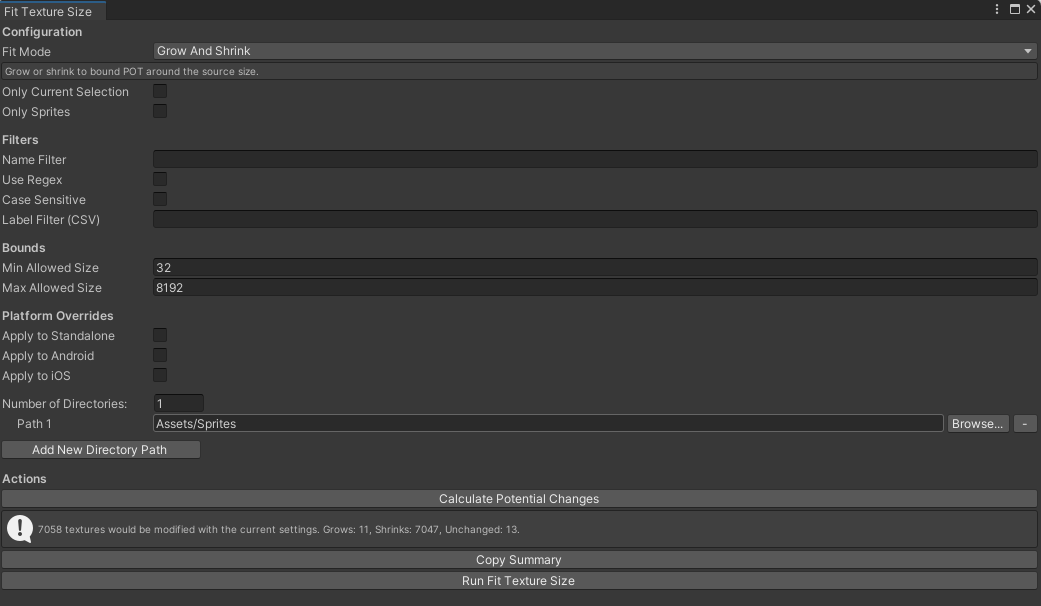
Purpose: Automatically adjust texture max size import settings to match actual source dimensions (power-of-two).
Key Features:
- Grow and Shrink: Adjust to perfect fit (default)
- Grow Only: Only increase max size if too small
- Shrink Only: Only decrease max size if too large
- Preview mode: Calculate changes before applying
- Batch processing: Process entire directories at once
Fit Modes:
GrowAndShrink:
- Sets max texture size to the nearest power-of-2 that fits the source
- Example: 1500x800 source → 2048 max size
- Prevents both over-allocation and quality loss
GrowOnly:
- Increases max size if the source is larger
- Never decreases size
- Useful for preventing quality loss on imports
ShrinkOnly:
- Decreases max size if the source is smaller
- Never increases size
- Useful for reducing memory usage
Workflow:
1. Open Fit Texture Size
2. Select Fit Mode (GrowAndShrink/GrowOnly/ShrinkOnly)
3. Add texture folders to process
4. Click "Calculate Potential Changes" to preview
5. Review how many textures will be modified
6. Click "Run Fit Texture Size" to apply
Example:
Source Texture: 1920x1080 pixels
Current Max Size: 512
Fit Mode: GrowAndShrink
Result: Max Size → 2048 (fits source dimensions)

Source Texture: 64x64 pixels
Current Max Size: 2048
Fit Mode: ShrinkOnly
Result: Max Size → 64 (matches source)
Algorithm:
- Reads actual source width/height (not imported size)
- Calculates required power-of-2:
size = max(width, height) - Rounds up to the next power-of-2 (32, 64, 128, 256, 512, 1024, 2048, 4096, 8192)
- Applies based on fit mode constraints
Best For:
- Fixing texture import settings after bulk imports
- Optimizing memory usage automatically
- Ensuring quality matches source resolution
- Standardizing texture settings across the project
- Build size optimization
Performance:
- Non-destructive (only changes import settings)
- Uses AssetDatabase batch editing for speed
- Progress bar for large operations
- Cancellable during processing
Visual Reference
Fit Texture Size with GrowAndShrink/GrowOnly/ShrinkOnly mode selection
Animation Tools
Sprite Animation Editor (Animation Viewer Window)
Menu: Tools > Wallstop Studios > Unity Helpers > Sprite Animation Editor
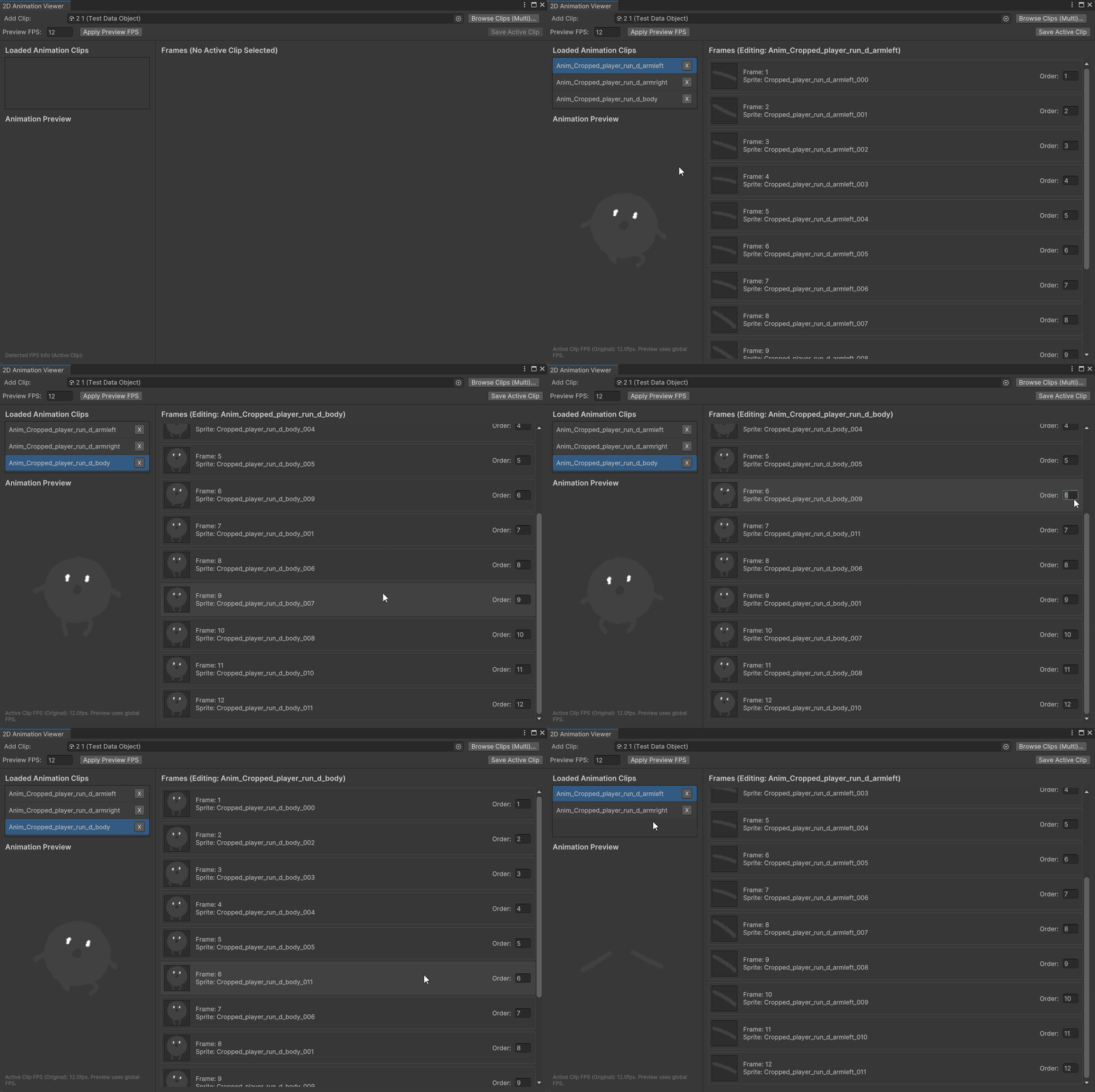
Purpose: Visual editor for 2D sprite animations with real-time preview and frame manipulation.
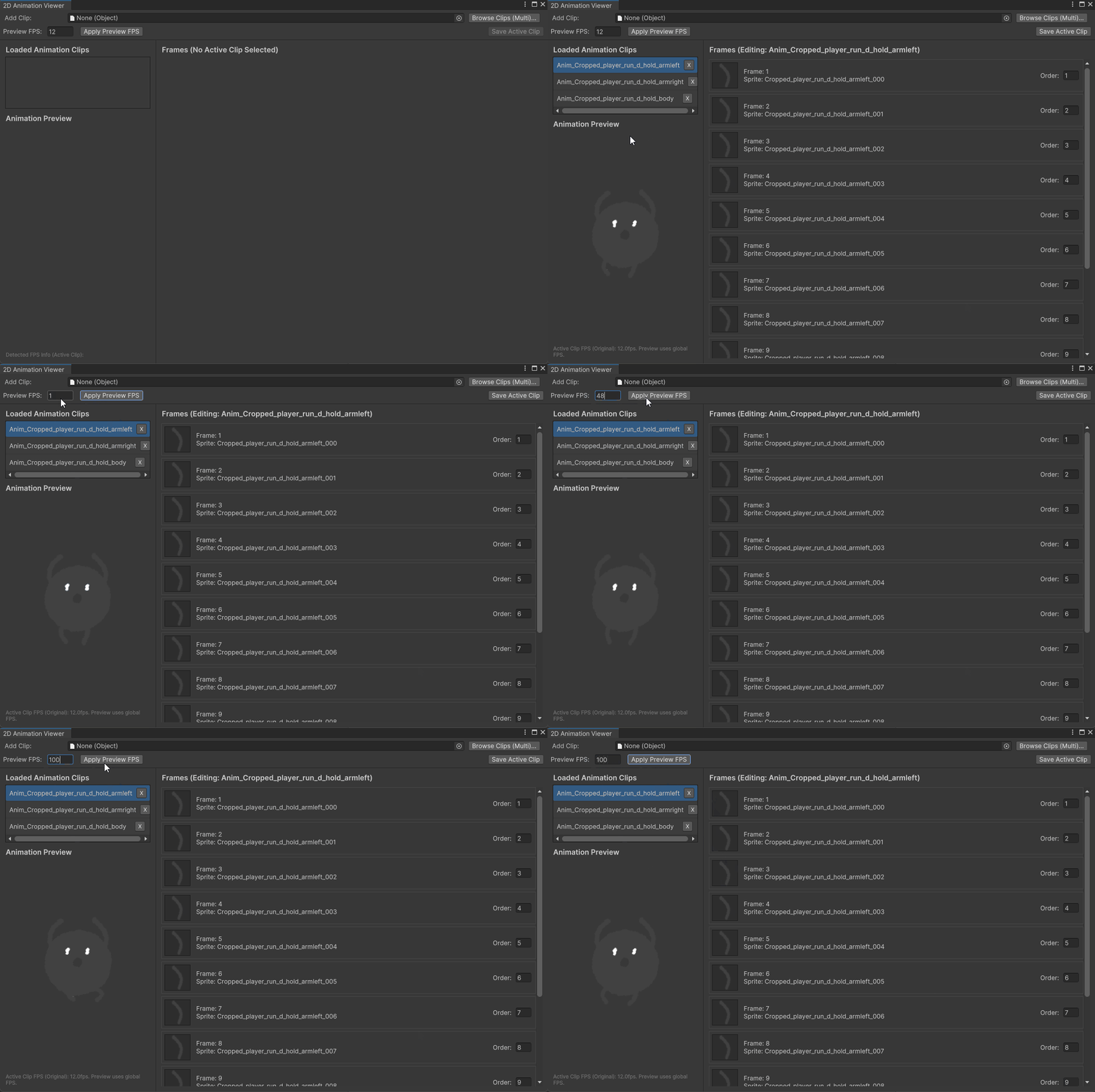
Key Features:
- Real-time preview: See animations as you edit
- Multi-layer support: Preview multiple clips simultaneously
- Drag-and-drop reordering: Intuitive frame organization
- FPS control: Adjust playback speed independently
- Frame management: Add/remove/reorder/duplicate frames
- Multi-file browser: Quick batch loading
- Binding preservation: Maintains SpriteRenderer paths
Typical Workflow:
1. Open Sprite Animation Editor
2. Click "Browse Clips (Multi)..." to select animations
3. Click a loaded clip in left panel to edit
4. Drag frames in "Frames" panel to reorder
5. Adjust FPS field and click "Apply FPS"
6. Preview updates in real-time
7. Click "Save Clip" to write changes
Example Session:
// Edit walk cycle animation:
1. Load "PlayerWalk.anim"
2. Preview plays at original 12 FPS
3. Drag frame 3 to position 1 (change starting pose)
4. Change FPS to 10 for slower walk
5. Click "Apply FPS" to preview
6. Click "Save Clip" to finalize
Best For:
- Tweaking animation timing without re-export
- Creating variations by reordering frames
- Previewing character animation sets
- Testing different FPS values
- Quick prototyping from sprite sheets
- Fixing frame order mistakes
Tips:
- Use the multi-file browser for entire animation sets
- Preview updates automatically while dragging
- FPS changes only affect the preview until saved
- Type frame numbers for precise positioning
- Press Enter to apply frame changes
Visual Demo
Drag-and-drop frame reordering with real-time preview updates
Adjusting FPS slider and seeing immediate preview speed change
Animation Creator
Menu: Tools > Wallstop Studios > Unity Helpers > Animation Creator
Purpose: Bulk‑create AnimationClips from sprite naming patterns — one‑click generation from folders of sprites. Eliminates manual clip setup and ensures consistent naming, ordering, and FPS/loop settings.
Problems Solved:
- Manual and error‑prone clip creation from many sprites
- Inconsistent frame ordering (lexicographic vs. numeric)
- Collisions/duplicates when generating many clips at once
- Repeating busywork when adding suffixes/prefixes across sets
Key Features:
- Folder sources with regex sprite filtering (
spriteNameRegex) - Auto‑parse into clips using naming patterns (one click)
- Custom group regex with named groups
(?<base>)(?<index>) - Case‑insensitive grouping and numeric sorting toggle
- Prefix clip names with a leaf folder or full folder path
- Auto‑parse name prefix/suffix and duplicate‑name resolution
- Dry‑run and preview (see groups and final asset paths)
- Per‑clip FPS and loop flag; bulk name append/remove
- “Populate First Slot with X Matched Sprites” helper
Common Naming Patterns (auto‑detected):
Player_Idle_0.png, Player_Idle_1.png, ...       // base: Player_Idle, index: 0..N
slime-walk-01.png, slime-walk-02.png            // base: slime-walk, index: 1..N
Mage/Attack (0).png, Mage/Attack (1).png        // base: Mage_Attack, index: 0..N (folder prefix optional)
Custom Group Regex Examples:
// Named groups are optional but powerful when needed
^(?<base>.*?)(?:_|\s|-)?(?<index>\d+)\.[Pp][Nn][Gg]$   // base + trailing digits
^Enemy_(?<base>Walk)_(?<index>\d+)$                      // narrow to specific clip type
How To Use (one‑click flow):
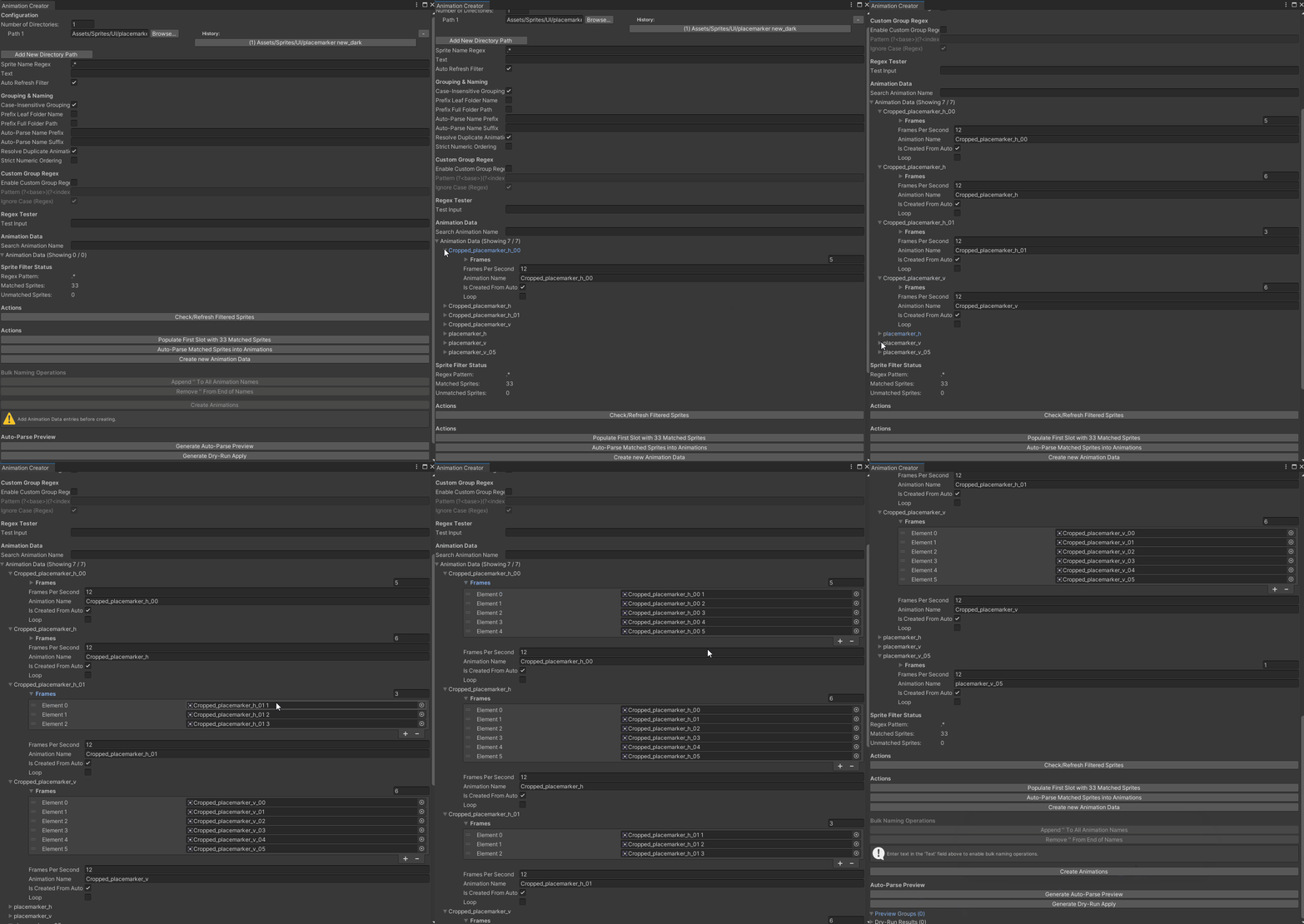
1) Open Animation Creator
2) Add one or more source folders
3) (Optional) Set sprite filter regex to narrow matches
4) Click “Auto‑Parse Matched Sprites into Animations”
5) Review generated Animation Data (set FPS/loop per clip)
6) Click “Create” (Action button) to write .anim assets
Preview & Safety:
- Use “Generate Auto‑Parse Preview” to see detected groups
- Use “Generate Dry‑Run Apply” to see final clip names/paths
- Toggle “Strict Numeric Ordering” to avoid
1,10,11,2,…issues - Enable “Resolve Duplicate Animation Names” to auto‑rename
Tips:
- Keep sprite names consistent (e.g.,
Name_Action_###) - Use the built‑in Regex Tester before applying
- Use folder name/path prefixing to avoid collisions across sets
- Batch rename tokens with the “Bulk Naming Operations” section
Best For:
- One‑click bulk clip creation from sprite folders
- Converting exported frame sequences into clips
- Large projects standardizing animation naming and FPS/loop
Visual Demo
One-click auto-parse: sprites grouped by naming pattern, clips generated instantly
Related Tools:
- After creating animations, edit timing with Sprite Animation Editor
- Add events to created animations with Animation Event Editor
- Organize animations between folders with Animation Copier
- For sprite sheets (not sequences), use Sprite Sheet Animation Creator
Animation Copier
Menu: Tools > Wallstop Studios > Unity Helpers > Animation Copier
Purpose: Analyze, duplicate, and synchronize AnimationClips between source and destination folders with previews, dry‑runs, and cleanup actions.
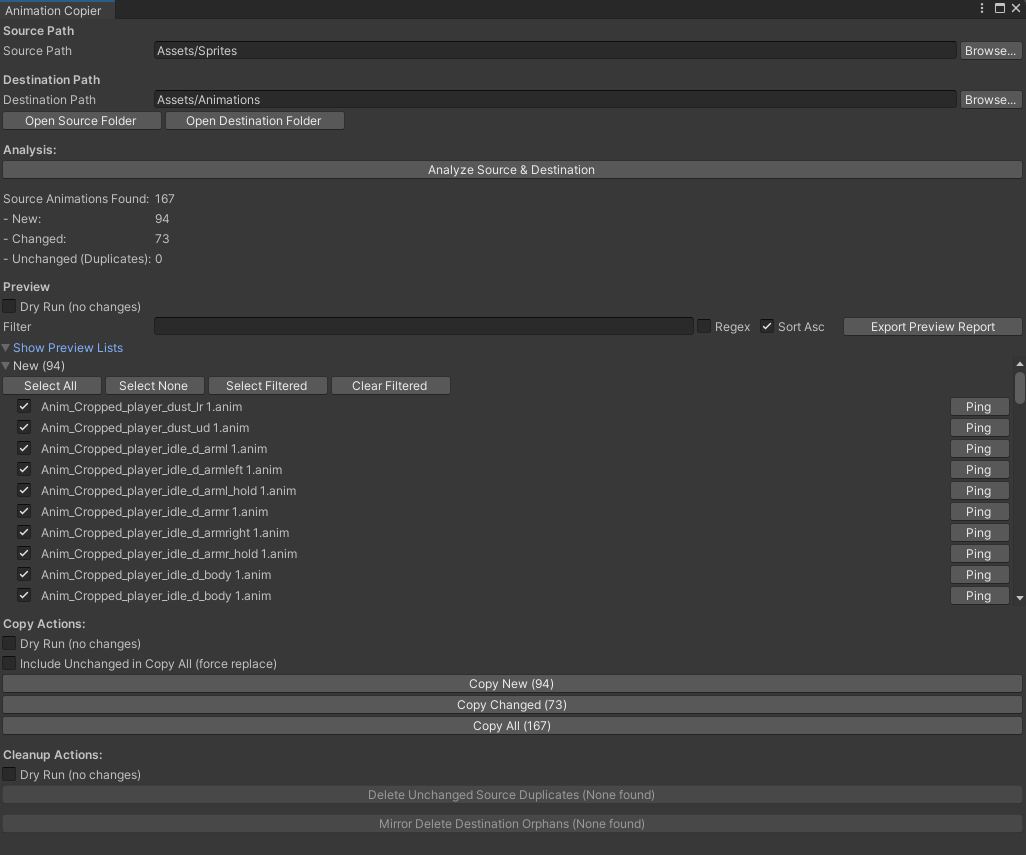
What It Analyzes:
- New: exist in the source but not the destination
- Changed: exist in both but differ (hash mismatch)
- Unchanged: identical in both (duplicates)
- Destination Orphans: only in destination
Workflow:
1) Open Animation Copier
2) Select Source Path (e.g., Assets/Sprites/Animations)
3) Select Destination Path (e.g., Assets/Animations)
4) Click “Analyze Source & Destination”
5) Review New/Changed/Unchanged/Orphans tabs (filter/sort)
6) Choose a copy mode:
   - Copy New / Copy Changed / Copy All (optional force replace)
7) (Optional) Dry Run to preview without writing
8) Use Cleanup:
   - Delete Unchanged Source Duplicates
   - Delete Destination Orphans
Safety & Options:
- Dry Run (no changes) for all copy/cleanup operations
- “Include Unchanged in Copy All” to force overwrite duplicates
- Open Source/Destination folder buttons for quick navigation
Best For:
- Creating animation variants and organizing libraries
- Syncing generated clips into your canonical destination
- Keeping animation folders tidy with cleanup actions
Visual Reference
Animation Copier with new/changed/unchanged/orphan tabs and copy actions
Sprite Sheet Animation Creator
Menu: Tools > Wallstop Studios > Unity Helpers > Sprite Sheet Animation Creator
Purpose: Turn a sliced sprite sheet into one or more AnimationClips with live preview, drag‑to‑select sprite ranges, and per‑clip FPS/loop/cycle offset.
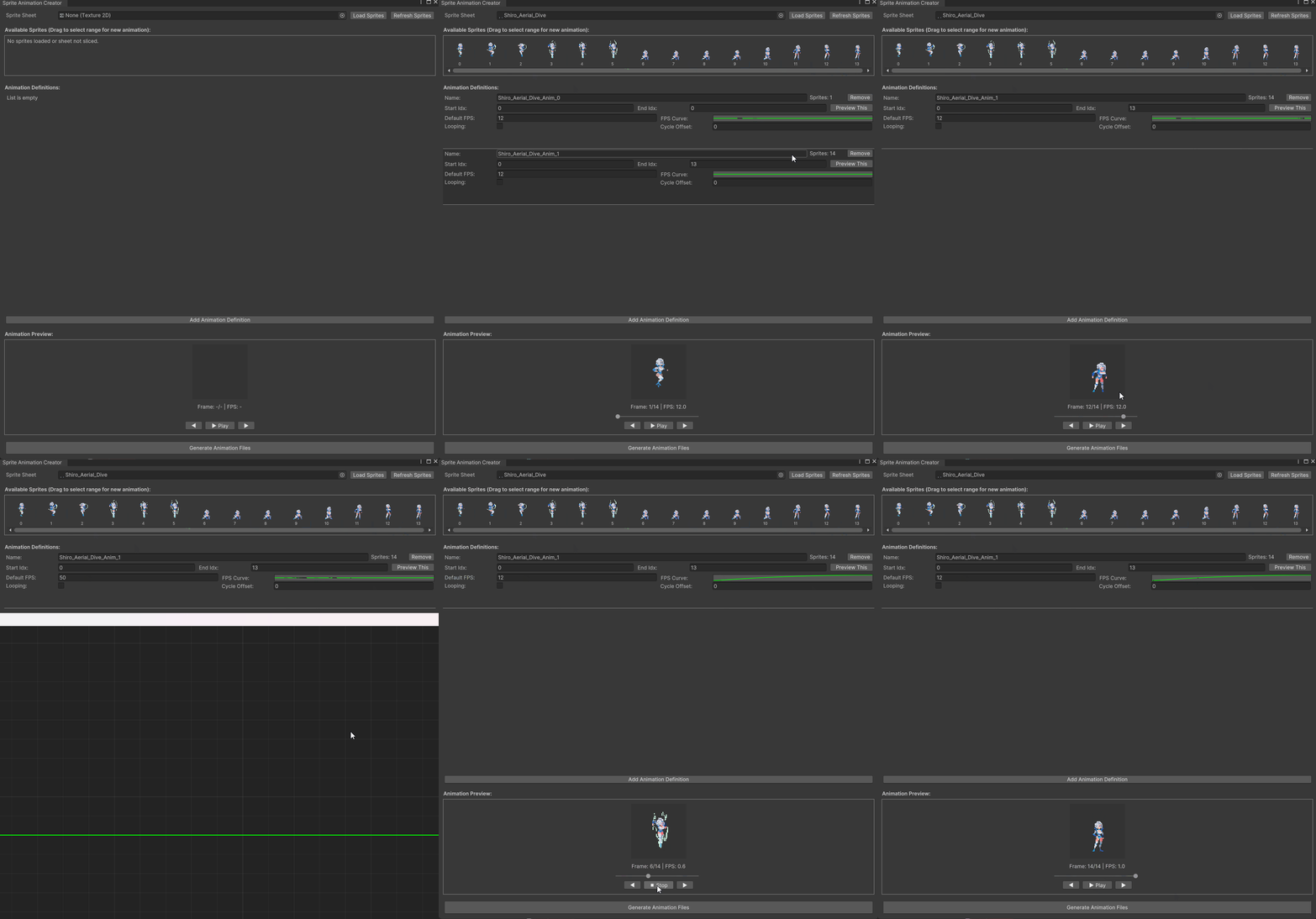
Key Features:
- Load a multi‑sprite Texture2D (sliced in the Sprite Editor)
- Drag‑select sprite ranges to define clips visually
- Constant FPS or curve‑based frame rate per clip
- Live preview/playback controls and scrubbing
- Loop toggle and cycle offset per clip
- Safe asset creation with unique file names
Usage:
1) Open Sprite Sheet Animation Creator
2) Drag a sliced Texture2D (or use the object field)
3) Select frames (drag across thumbnails) to define a clip
4) Name the clip, set FPS/curve, loop, cycle offset
5) Repeat to add multiple definitions
6) Click “Generate Animations” and choose output folder
Best For:
- Converting sprite sheets to animation clips with fine control
- Mixed timings using AnimationCurves for frame pacing
- Fast iteration via visual selection and preview
Visual Demo
Drag-select frame ranges on sprite sheet thumbnails with instant preview playback
Animation Event Editor
Menu: Tools > Wallstop Studios > Unity Helpers > AnimationEvent Editor
Purpose: Advanced visual editor for creating and managing animation events with sprite preview, method auto-discovery, and parameter editing.
Key Features:
- Sprite preview: See the sprite at each event time
- Method auto-discovery: Automatically finds valid animation event methods
- Explicit mode: Restrict to methods marked with
[AnimationEvent]attribute - Parameter editing: Visual editors for int, float, string, object, and enum parameters
- Frame-based editing: Work with frame numbers instead of time values
- Search filtering: Filter types and methods by search terms
- Real-time validation: Shows invalid texture rects and read/write issues
Workflow:
1. Open Animation Event Editor
2. Drag Animator component into "Animator Object" field
3. Select animation from dropdown (or use Animation Search)
4. Set "FrameIndex" for new event
5. Click "Add Event" to create event at that frame
6. Configure event:
   a. Select TypeName (MonoBehaviour with event methods)
   b. Select MethodName from available methods
   c. Set parameters (int, float, string, object, enum)
7. Reorder events if needed (Move Up/Down buttons)
8. Click "Save" to write changes to animation clip
Modes:
Explicit Mode (Default):
- Only shows methods marked with
[AnimationEvent]attribute - Cleaner, curated list of event methods
- Recommended for large projects
Non-Explicit Mode:
- Shows all public methods with valid signatures
- Use the “Search” field to filter by type/method name
- Good for discovery and prototyping
Control Frame Time:
- Disabled: Work with frame indices (snaps to frames)
- Enabled: Edit precise time values (floating point)
Sprite Preview:
- Automatically shows sprite at event time
- Requires texture Read/Write enabled
- “Fix” button to enable Read/Write if needed
- Warns if a sprite is packed too tightly
Event Management:
Adding Events:
- Set “FrameIndex” to desired frame
- Click “Add Event”
- Event created at frame time
Editing Events:
- Change frame/time directly
- Select type and method from dropdowns
- Edit parameters based on method signature
- Override enum values if needed
Reordering:
- “Move Up”/”Move Down” for events at the same time
- “Re-Order” button sorts all events by time
- Maintains proper event order for playback
Resetting:
- Per-event “Reset” button (reverts to saved state)
- Global “Reset” button (discards all changes)
Parameter Types Supported:
int- IntField editorfloat- FloatField editorstring- TextField editorUnityEngine.Object- ObjectField editorEnum- Dropdown with an override option
Best For:
- Complex animation event setup
- Character combat systems
- Footstep/sound effect events
- Particle effect triggers
- Animation state notifications
- Visual debugging of event timing
Tips:
- Enable “Explicit Mode” to reduce clutter
- Use “Animation Search” for quick filtering
- Frame numbers are more intuitive than time values
- Sprite preview helps verify timing
- Multiple events can exist at the same frame
- Use “Re-Order” before saving for consistency
Common Method Signatures:
using WallstopStudios.UnityHelpers.Core.Attributes;

public class CharacterAnimationEvents : MonoBehaviour
{
    [AnimationEvent]  // Shows in Explicit Mode
    public void PlayFootstep() { }

    [AnimationEvent]
    public void SpawnEffect(string effectName) { }

    [AnimationEvent]
    public void ApplyDamage(int damage) { }

    [AnimationEvent]
    public void SetAnimationState(CharacterState state) { }  // Enum parameter
}
Sprite Atlas Tools
Sprite Atlas Generator
Menu: Tools > Wallstop Studios > Unity Helpers > Sprite Atlas Generator
Purpose: Comprehensive tool for creating and managing Unity Sprite Atlases with regex-based sprite selection, label filtering, and automated packing.
Key Features:
- Regex-based sprite selection: Use regular expressions to automatically find sprites
- Label filtering: Select sprites based on Unity asset labels
- Multiple source folders: Configure different folders with different selection criteria
- Batch atlas generation: Create/update multiple atlases at once
- Advanced packing settings: Control texture size, compression, padding, rotation
- Source sprite utilities: Force uncompressed settings for source sprites
- Scan and preview: See what sprites will be added/removed before applying changes
Configuration Asset:
Create configurations via Assets > Create > Wallstop Studios > Unity Helpers > Scriptable Sprite Atlas Config
ScriptableSpriteAtlas Configuration:
Sprite Sources:
- spritesToPack: Manually added sprites (always included)
- sourceFolderEntries: Define folders with regex/label filters

Source Folder Entry Options:
- folderPath: Folder to scan (relative to Assets/)
- selectionMode: Regex | Labels | Both
- regexes: List of regex patterns (all must match - AND logic)
- regexAndTagLogic: How to combine regex and labels (And/Or)
- labelSelectionMode: All | AnyOf
- labels: Asset labels to filter by

Output Atlas Settings:
- outputSpriteAtlasDirectory: Where to save .spriteatlas
- outputSpriteAtlasName: Name of atlas file

Packing Settings:
- maxTextureSize: 32-16384 (power of 2)
- enableRotation: Allow sprite rotation for better packing
- padding: Pixels between sprites (0-32)
- enableTightPacking: Optimize packing density
- enableAlphaDilation: Dilate alpha edges
- readWriteEnabled: Enable Read/Write on atlas texture

Compression Settings:
- useCrunchCompression: Enable crunch compression
- crunchCompressionLevel: 0-100 quality
- compression: Compressed/CompressedHQ/Uncompressed
Typical Workflow:
1. Open Sprite Atlas Generator
2. Click "Create New Config in 'Assets/Data'"
3. Configure the new atlas:
   a. Set output name and directory
   b. Click "Add New Source Folder Entry"
   c. Select folder containing sprites
   d. Add regex patterns (e.g., "^character_.*\\.png$")
   e. Or/and add labels for filtering
   f. Configure packing settings (texture size, padding, etc.)
4. Click "Scan Folders for '[config name]'"
5. Review sprites to add/remove
6. Click "Add X Sprites" to populate the list
7. Click "Generate/Update '[atlas name].spriteatlas' ONLY"
8. Click "Pack All Generated Sprite Atlases" to pack textures
Example Configurations:
Character Sprites Atlas:
folderPath: Assets/Sprites/Characters
selectionMode: Regex
regexes: ["^player_.*\\.png$", ".*_idle_.*"]
maxTextureSize: 2048
padding: 4
compression: CompressedHQ
UI Icons by Label:
folderPath: Assets/Sprites/UI
selectionMode: Labels
labelSelectionMode: AnyOf
labels: ["icon", "ui"]
maxTextureSize: 1024
padding: 2
Combined Regex + Labels:
folderPath: Assets/Sprites/Effects
selectionMode: Regex | Labels
regexes: ["^vfx_.*"]
labels: ["particle"]
regexAndTagLogic: And
maxTextureSize: 2048
Advanced Features:
Scan and Preview:
- Shows the exact sprite count that will be added/removed
- Prevents accidental overwrites
- Displays current vs. scanned sprite lists
Source Sprite Utilities:
- “Force Uncompressed for X Source Sprites” button
- Sets source sprites to uncompressed (RGBA32/RGB24)
- Disables crunch compression on sources
- Ensures maximum quality before atlas packing
Batch Operations:
- “Generate/Update All .spriteatlas Assets” - processes all configs
- “Pack All Generated Sprite Atlases” - packs all atlases in the project
- Progress bars for long operations
Best For:
- Managing large sprite collections
- Automating sprite atlas creation
- Consistent atlas configuration across the team
- Dynamic sprite selection based on naming conventions
- Organizing sprites by labels/tags
- Build pipeline atlas generation
Tips:
- Use regex for consistent naming patterns
- Combine multiple source folders for complex selections
- Test regex patterns with “Scan Folders” before generating
- Keep source sprites uncompressed for the best atlas quality
- Use labels for cross-folder sprite grouping
- Regular expressions use case-insensitive matching
Common Issues:
- No sprites found: Check regex patterns and folder paths
- Sprites not packing: Run “Pack All Generated Sprite Atlases”
- Quality issues: Use “Force Uncompressed” on source sprites
- Regex errors: Validate patterns (will log specific errors)
Visual Reference
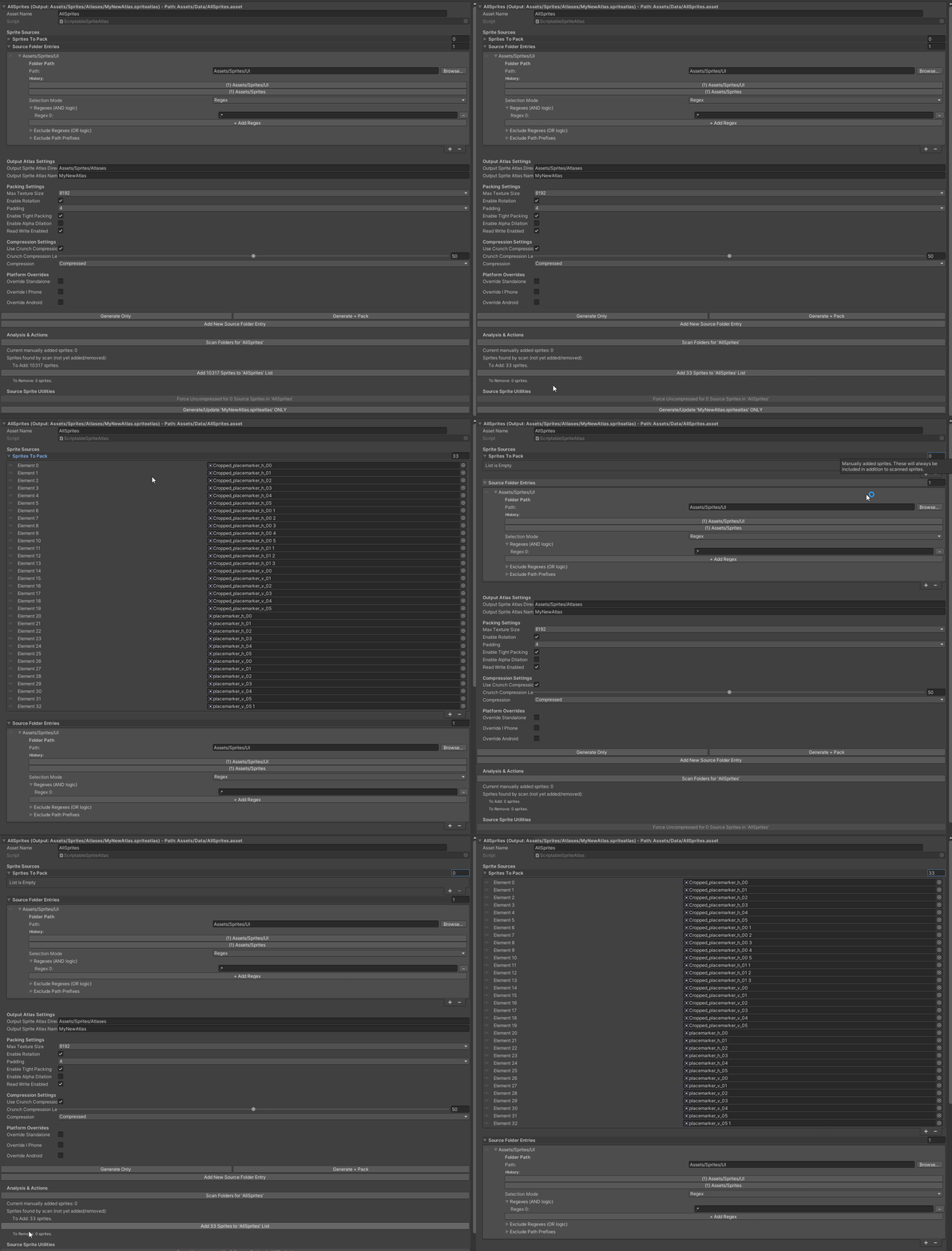
Sprite Atlas Generator with regex-based sprite selection and packing settings
Scanning folders and previewing which sprites will be added to the atlas

Validation & Quality Tools
Prefab Checker
Menu: Tools > Wallstop Studios > Unity Helpers > Prefab Checker
Purpose: Comprehensive prefab validation to detect configuration issues before runtime.
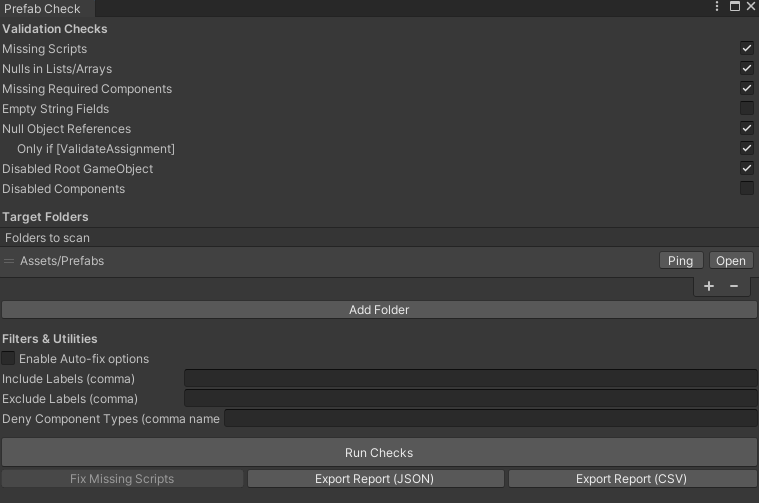
Validation Checks:
| Check | Description | Severity |
|---|---|---|
| Missing Scripts | Detects broken MonoBehaviour references | Critical |
| Nulls in Lists/Arrays | Finds null elements in serialized collections | High |
| Missing Required Components | Validates [RequireComponent] dependencies | Critical |
| Empty String Fields | Identifies unset string fields | Medium |
| Null Object References | Finds unassigned UnityEngine.Object fields | High |
| Only if [ValidateAssignment] | Restricts null checks to annotated fields | Configurable |
| Disabled Root GameObject | Flags inactive prefab roots | Medium |
| Disabled Components | Reports disabled Behaviour components | Low |
Typical Validation Workflow:
// Before committing prefab changes:
1. Open Prefab Checker
2. Enable relevant checks (especially Missing Scripts, Required Components)
3. Add "Assets/Prefabs" folder
4. Click "Run Checks"
5. Review console output (click to select problematic prefabs)
6. Fix reported issues
7. Re-run checks to verify
8. Commit changes
CI/CD Integration:
// Can be scripted for automated builds
- Run validation on changed prefab folders
- Parse console output for errors
- Fail build if critical issues found
Best Practices:
- Use
[ValidateAssignment]attribute on critical fields - Run checks before committing prefab changes
- Enable “Only if [ValidateAssignment]” to reduce noise
- Fix “Missing Required Components” errors immediately
- Schedule regular validation runs
Performance: Uses cached reflection for fast repeated checks.
Best For:
- Pre-build validation
- Code review assistance
- Team onboarding with prefab standards
- Migration validation after Unity upgrades
- Continuous integration health checks
Visual Reference
Prefab Checker with configurable validation checks and folder selection
Console output showing detected prefab issues with clickable links

Unity Method Analyzer
Menu: Tools > Wallstop Studios > Unity Helpers > Unity Method Analyzer
Purpose: Detect inheritance issues and Unity lifecycle method errors across your entire C# codebase before they cause runtime bugs.
📖 Full Documentation: Unity Method Analyzer Guide
Key Features:
- Static analysis without external dependencies (no Roslyn required)
- Parallel scanning of thousands of files
- Multiple issue categories: Unity Lifecycle, Unity Inheritance, General Inheritance
- Five severity levels: Critical, High, Medium, Low, Info
- Export options: JSON and Markdown for CI/CD integration
- Flexible filtering: By severity, category, or free-text search
What It Detects:
| Issue Type | Example |
|---|---|
Missing override keyword |
Hiding base method instead of overriding |
| Wrong Unity method signature | OnCollisionEnter(Collider c) instead of OnCollisionEnter(Collision c) |
| Shadowed lifecycle methods | Both base and derived class have private void Start() |
| Static lifecycle methods | static void Awake() won’t be called by Unity |
Quick Start:
1. Open Unity Method Analyzer
2. Add source directories (e.g., Assets/Scripts)
3. Click "Analyze Code"
4. Review issues grouped by file, severity, or category
5. Double-click to navigate to problematic code
6. Export report for team review or CI/CD
Visual Demo
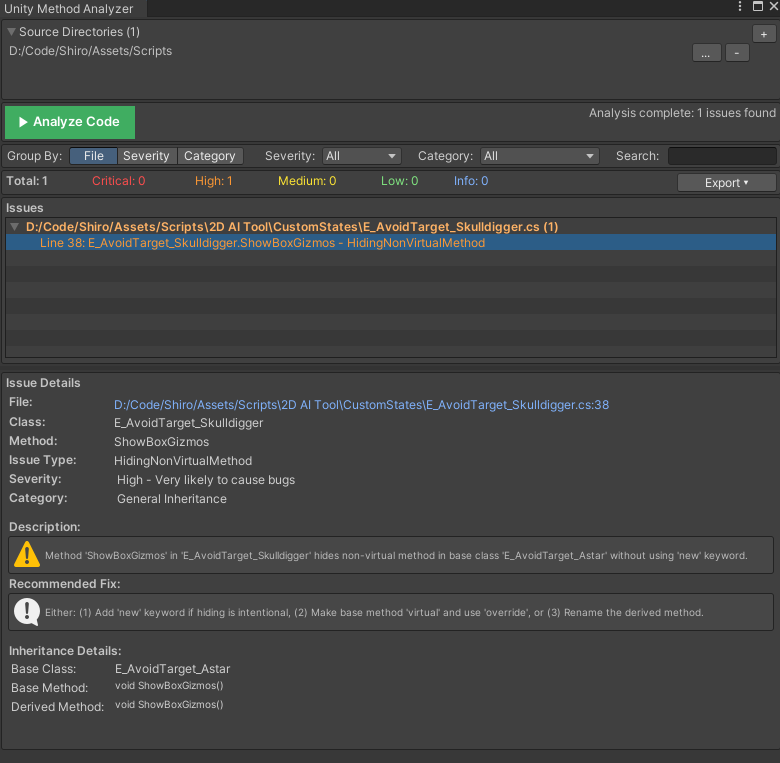
The analyzer scanning a project and displaying categorized issues
Suppressing Warnings:
For test code or intentional patterns, use [SuppressAnalyzer]:
[SuppressAnalyzer("Test fixture for analyzer validation")]
public class TestClassWithIntentionalIssues : BaseClass
{
    public void HiddenMethod() { }  // Won't trigger warning
}
Best For:
- Pre-commit code validation
- Code review assistance
- CI/CD quality gates
- Team onboarding
- Post-refactoring verification
Custom Component Editors
These custom inspectors enhance Unity components with additional functionality and convenience features.
MatchColliderToSprite Editor
Component: MatchColliderToSprite
Purpose: Provides a button in the inspector to manually trigger collider-to-sprite matching.
Features:
- “MatchColliderToSprite” button in inspector
- Manually invoke
OnValidate()to update collider - Useful when automatic updates don’t trigger
When to Use:
- After changing sprite at runtime
- When collider doesn’t match sprite automatically
- Manual override of collider shape
PolygonCollider2DOptimizer Editor
Component: PolygonCollider2DOptimizer
Purpose: Custom inspector for optimizing PolygonCollider2D point counts with configurable tolerance.
Features:
- tolerance: Adjustable simplification tolerance
- Optimize button: Manually trigger polygon simplification
- Reduces collider complexity while maintaining shape
How It Works:
- Adjust tolerance slider (lower = more accurate, higher = simpler)
- Click “Optimize” to simplify polygon points
- Collider updates with a reduced point count
Best For:
- Reducing physics performance overhead
- Simplifying complex sprite colliders
- Balancing accuracy vs. performance
- Editor-time optimization of imported sprites
Tolerance Guide:
- 0.0 - 0.1: High accuracy, minimal simplification
- 0.1 - 0.5: Balanced (recommended)
- 0.5 - 2.0: Aggressive simplification
- 2.0+: Maximum simplification (may lose detail)
EnhancedImage Editor
Component: EnhancedImage (extends Unity’s Image)
Purpose: Extended inspector for EnhancedImage with HDR color support and shape mask configuration.
Additional Properties:
- HDR Color: High dynamic range color multiplication
- Shape Mask: Texture2D for masking/shaping the image
- Material Auto-Fix: Detects and fixes incorrect material assignment
Features:
Material Detection:
- Warns if using “Default UI Material”
- “Incorrect Material Detected - Try Fix?” button (yellow)
- Automatically finds and applies the correct BackgroundMask material
- Material path:
Shaders/Materials/BackgroundMask-Material.mat
Shape Mask:
- Requires shader with
_ShapeMasktexture2D property - Allows complex masking effects
- Integrates with a custom shader system
HDR Color:
- Color picker with HDR support
- Intensity values > 1.0 for bloom/glow effects
- Works with post-processing
Best For:
- UI elements requiring HDR effects
- Masked UI images
- Custom-shaped UI elements
- Material-based UI effects
Workflow:
1. Add EnhancedImage component to UI GameObject
2. If yellow "Fix Material" button appears, click it
3. Configure HDR Color for glow/intensity
4. Assign Shape Mask texture if needed
5. Shader must expose _ShapeMask property
Icon Customization:
- Automatically uses Image icon in project/hierarchy
- Seamless integration with standard Unity UI
Property Drawers & Attributes
Custom property drawers enhance the inspector with conditional display, validation, and specialized input fields.
WInLineEditor Property Drawer
Attribute: [WInLineEditor]
Purpose: Embed the inspector for object references (ScriptableObjects, Materials, Components, Textures, etc.) directly below the field so you can edit configuration without losing context.
Modes (WInLineEditorMode):
AlwaysExpanded— always draws the inline inspector.FoldoutExpanded— shows a foldout that starts expanded.FoldoutCollapsed— shows a foldout that starts collapsed.
Options: tune the presentation with constructor parameters:
inspectorHeight(default 200, min 160) — vertical space reserved for the inspector body.drawObjectField— hide or show the object picker next to the label.drawHeader— draw a bold header with a ping button (ping is shown only while a Project window tab is visible).drawPreview&previewHeight— render the preview area when the target editor exposes one.enableScrolling— wrap the inspector body in a scroll view for long inspectors.minInspectorWidth(default 520) — when the content area is narrower than this width, a horizontal scrollbar appears; set to0to disable the safeguard.
WInLineEditor respects the Inline Editors defaults inside Unity Helpers Settings. Leave the
modeargument unset to inherit the global foldout behaviour, or supply aWInLineEditorModeper field to override it. By default, Inline Editors start collapsed to mirror collapsible WGroups, so[WInLineEditor]without a mode expands only when you opt into a different setting.
Examples:
public class AbilityConfig : ScriptableObject
{
    public string displayName;
    public float cooldown;
}

public class AbilityDatabase : ScriptableObject
{
    [WInLineEditor] public AbilityConfig defaultConfig;

    [WInLineEditor(
        WInLineEditorMode.FoldoutCollapsed,
        inspectorHeight: 180f,
        drawPreview: true,
        previewHeight: 64f)]
    public Texture2D abilityIcon;

    [WInLineEditor(
        WInLineEditorMode.AlwaysExpanded,
        inspectorHeight: 220f,
        drawObjectField: false,
        enableScrolling: false)]
    public AbilityConfig sharedTemplate;
}
Features:
- Bespoke implementation (no Odin dependency) tailored to the most common inline editing workflows.
- Reuses Unity’s native editors, respecting custom inspectors, validation, and undo.
- Optional scroll view that keeps large inspectors usable without stealing space from the parent inspector.
- Preview support for assets that implement
HasPreviewGUI. - Header includes a quick “Ping” button so you can jump to the asset whenever the Project window is visible.
- Smooth expand/collapse animations with configurable speed.
Animation Settings:
Foldout animations are controlled via Unity Helpers Settings (Edit > Project Settings > Unity Helpers):
InlineEditorFoldoutTweenEnabled— Enable/disable smooth expand/collapse animations (default:true)InlineEditorFoldoutSpeed— Animation speed from 2.0 to 12.0 (default:2.0)
using UnityEngine;
using WallstopStudios.UnityHelpers.Core.Attributes;

public class AbilityConfig : ScriptableObject
{
    public string abilityName;
    public Sprite icon;
    public float cooldown;
}

public class WInLineEditorExample : MonoBehaviour
{
    // Animation applies to foldout modes only
    [WInLineEditor(WInLineEditorMode.FoldoutCollapsed)] // Animated
    public AbilityConfig animatedFoldout;

    [WInLineEditor(WInLineEditorMode.AlwaysExpanded)] // No animation (always visible)
    public AbilityConfig alwaysVisible;
}
See also: Inspector Settings Reference for complete settings documentation.
Visual Reference
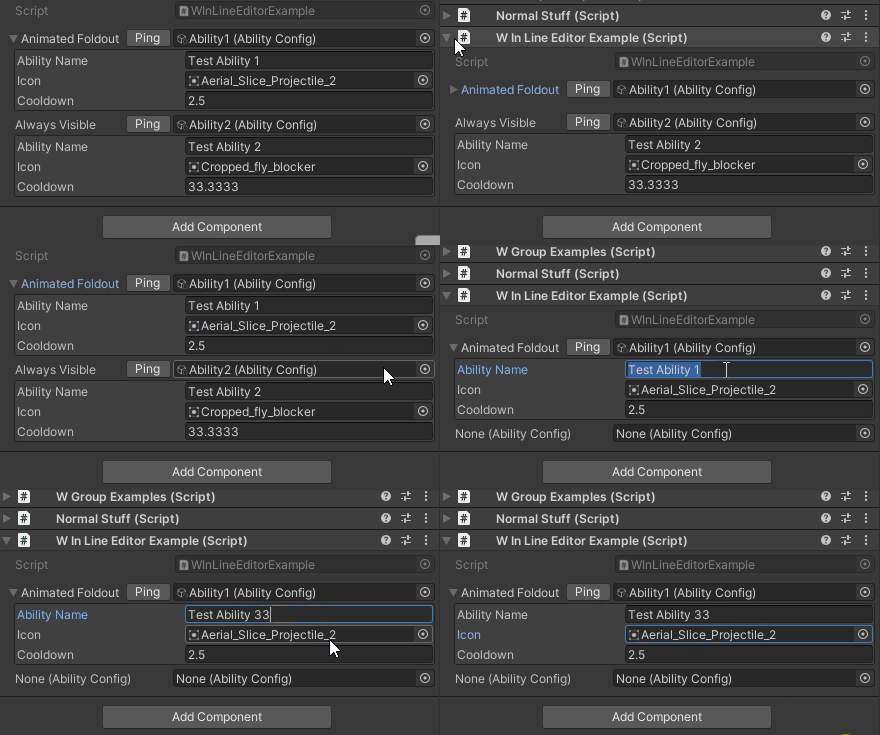
WInLineEditor with embedded inspector for a ScriptableObject reference with foldout and collapse transitions
WShowIf Property Drawer
Attribute: [WShowIf]
Purpose: Conditionally show/hide fields in inspector based on boolean fields or enum values.
Syntax:
[WShowIf(nameof(fieldName))]
[WShowIf(nameof(fieldName), inverse = true)]
[WShowIf(nameof(fieldName), expectedValues: new object[] { value1, value2 })]
[WShowIf(nameof(numericField), WShowIfComparison.GreaterThan, 10)]
[WShowIf(nameof(stringField), WShowIfComparison.IsNotNullOrEmpty)]
[WShowIf(nameof(parentField) + "." + nameof(ChildType.someFlag))]
WShowIfComparison.Unknownexists only for backward compatibility and is marked obsolete; always choose an explicit comparison mode.
Examples:
Boolean Condition:
public bool enableFeature;

[WShowIf(nameof(enableFeature))]
public float featureIntensity;

[WShowIf(nameof(enableFeature), inverse = true)]
public string disabledMessage;
Enum Condition:
public enum Mode { Simple, Advanced, Expert }
public Mode currentMode;

[WShowIf(nameof(currentMode), expectedValues = new object[] { Mode.Advanced, Mode.Expert })]
public int advancedSetting;
Multiple Values:
using System.Collections.Generic;
using UnityEngine;
using UnityEngine.Serialization;
using WallstopStudios.UnityHelpers.Core.Attributes;
using WallstopStudios.UnityHelpers.Core.DataStructure.Adapters;
using WallstopStudios.UnityHelpers.Editor.Sprites;

public class SelectionModeExample : MonoBehaviour
{
    public SpriteSelectionMode selectionMode;

    [WShowIf(
        nameof(selectionMode),
        expectedValues = new object[]
        {
            SpriteSelectionMode.Regex,
            SpriteSelectionMode.Regex | SpriteSelectionMode.Labels,
        }
    )]
    public List<string> regexPatterns;

    [FormerlySerializedAs("regexPatterns")]
    [WShowIf(
        nameof(selectionMode),
        expectedValues = new object[]
        {
            SpriteSelectionMode.Regex,
            SpriteSelectionMode.Regex | SpriteSelectionMode.Labels,
        }
    )]
    public SerializableHashSet<string> regexPatterns1;

    [WShowIf(
        nameof(selectionMode),
        expectedValues = new object[]
        {
            SpriteSelectionMode.Regex,
            SpriteSelectionMode.Regex | SpriteSelectionMode.Labels,
        }
    )]
    public SerializableDictionary<int, string> regexPatterns2;

    public bool someOtherField;
}
Features:
- Hides field when condition false (0 height)
- Supports boolean, enum, numeric, any
IComparable/IComparable<T>type, null, and string/collection comparisons - Allows referencing nested paths, properties, and parameterless methods
inverseparameter inverts any comparison resultexpectedValues(or params arguments) for equality checks without manual arrays- Falls back to reflection for non-SerializedProperty fields
- Cached reflection for performance
Best For:
- Conditional inspector fields
- Reducing inspector clutter
- Mode-based configuration UI
- Complex nested settings
Visual Reference
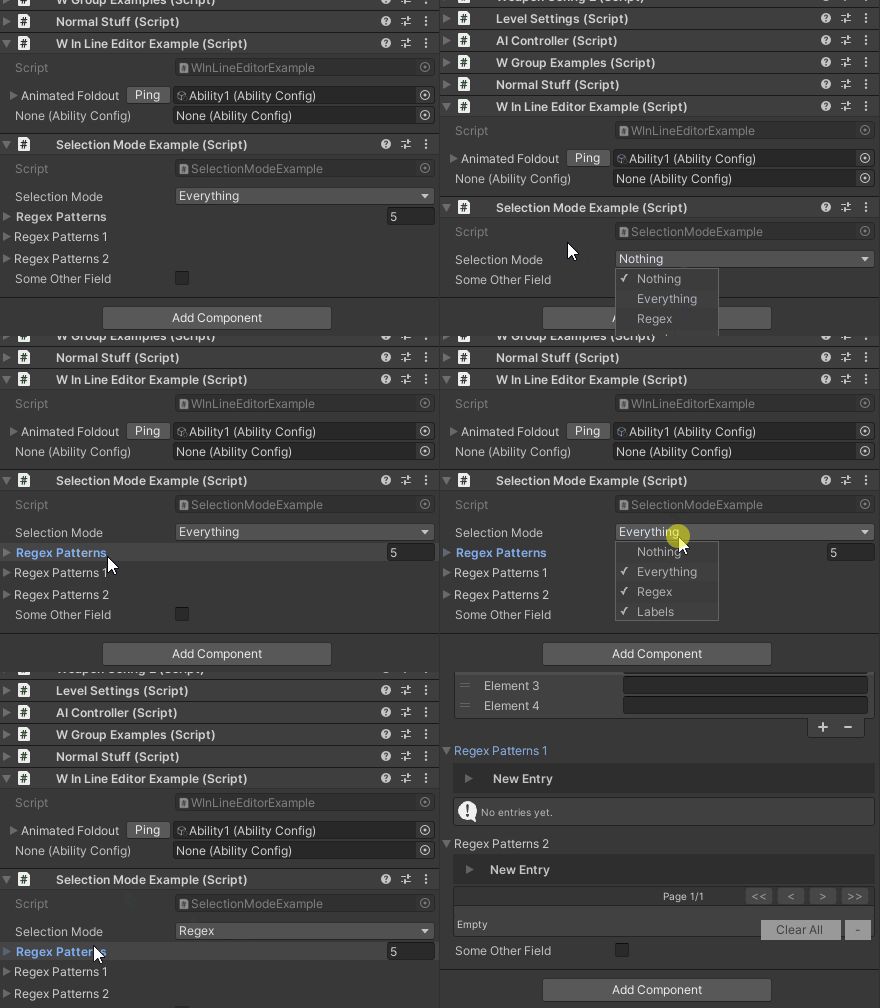
Field appears/disappears based on enum toggle state
StringInList Property Drawer
Attribute: [StringInList]
Purpose: Display string or int fields as dropdown with predefined options.
Syntax:
// Static array
[StringInList("Option1", "Option2", "Option3")]
public string selectedOption;

// Method reference
[StringInList(typeof(MyClass), nameof(MyClass.GetOptions))]
public string dynamicOption;

// With int field
[StringInList("Low", "Medium", "High")]
public int priorityIndex;
Dynamic Options Example:
using WallstopStudios.UnityHelpers.Core.Helper;

public class MySettings
{
    [StringInList(typeof(Helpers), nameof(Helpers.GetAllSpriteLabelNames))]
    public List<string> selectedLabels;
}
Features:
- String fields: Dropdown with string values
- Int fields: Dropdown with indices
- Arrays/Lists: UI Toolkit list view with per-element dropdowns, add/remove, and drag-to-reorder
- Dynamic lists via static method reference
- Search/filter with lightweight autocomplete (Tab auto-completes and assigns, Enter just fills the search)
- Inline hint beneath the search box shows the current best match for quick Tab acceptance
- Pagination automatically appears when the option count exceeds the configured page size
- Page size configurable via Project Settings ▸ Wallstop Studios ▸ Unity Helpers ▸ StringInList Page Size
- Auto-finds current value in list
- The same search + pagination experience is reused by
SerializableType, so adjusting the page size updates both drawers
Best For:
- Predefined option selection
- Tag/label selection
- Enum-like string fields
- Dynamic option lists
- User-friendly enumerations
using System.Collections.Generic;
using UnityEngine;
using WallstopStudios.UnityHelpers.Core.Attributes;

public class StringInListExample : MonoBehaviour
{
    [StringInList(typeof(StringInListExample), nameof(GetValues))]
    public string value;

    private IEnumerable<string> GetValues()
    {
        yield return "A";
        yield return "B";
        yield return "C";
        yield return "D";
    }
}
Visual Reference
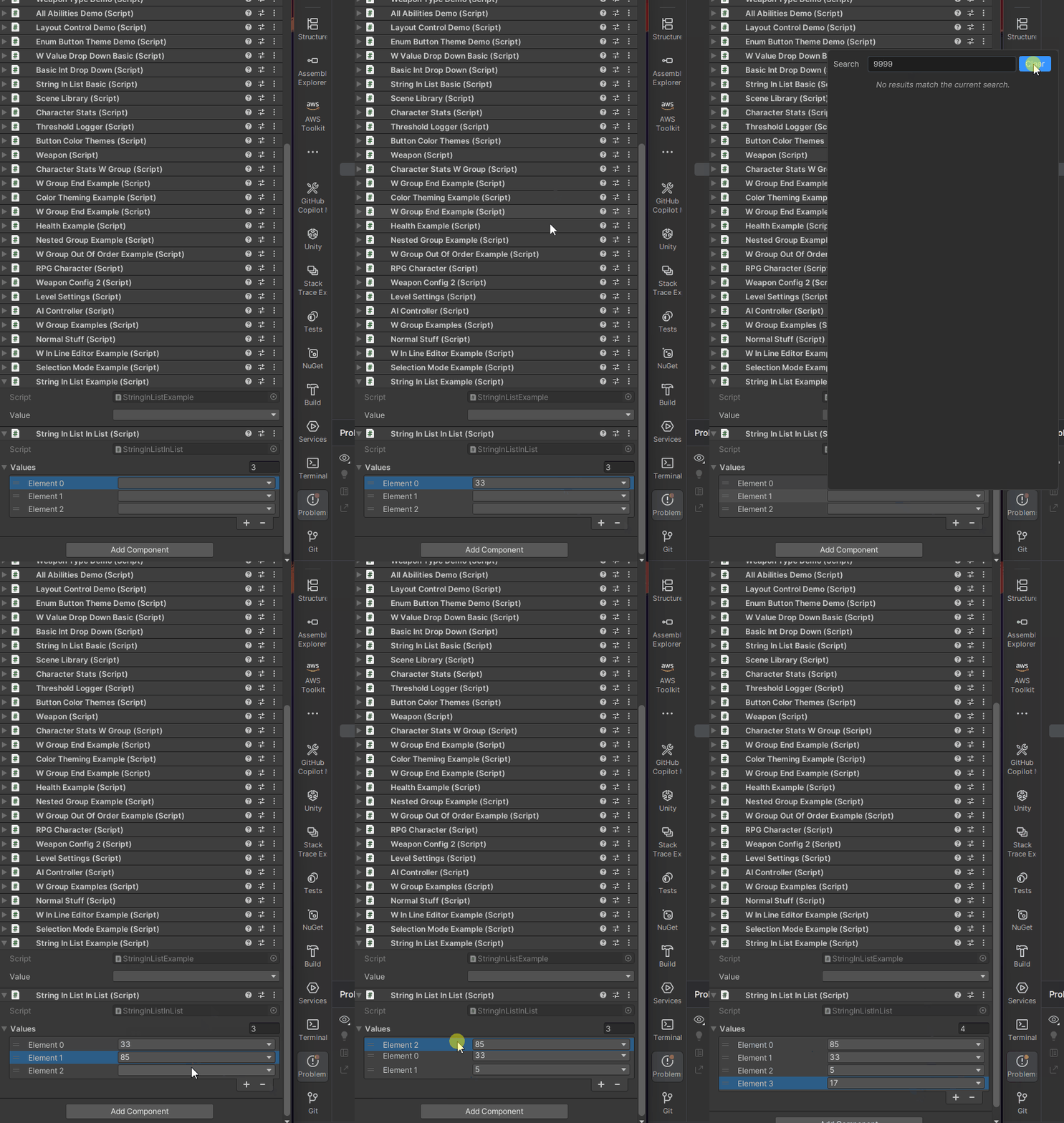
StringInList dropdown showing search filtering and pagination

using System.Collections.Generic;
using UnityEngine;
using WallstopStudios.UnityHelpers.Core.Attributes;

public class StringInListExample : MonoBehaviour
{
    [StringInList(typeof(StringInListExample), nameof(GetValues))]
    public string value;

    private IEnumerable<string> GetValues()
    {
        yield return "A";
        yield return "B";
        yield return "C";
        yield return "D";
    }
}
Visual Reference
StringInList on a List field with per-element dropdowns and drag reordering
IntDropdown Property Drawer
Attribute: [IntDropdown]
Purpose: Display int fields as dropdown with specific integer options.
Syntax:
[IntDropdown(32, 64, 128, 256, 512, 1024, 2048, 4096, 8192)]
public int textureSize;

[IntDropdown(0, 2, 4, 8, 16, 32)]
public int padding;
Features:
- Restricts int values to specific options
- Dropdown shows integer values as strings
- Prevents invalid values
- Visual clarity for constrained integers
Best For:
- Power-of-two values (texture sizes)
- Discrete numeric options
- Preventing invalid integer input
- Configuration with specific valid values
Common Use Cases:
using UnityEngine;
using WallstopStudios.UnityHelpers.Core.Attributes;

public class IntDropDownExample : MonoBehaviour
{
    // Texture sizes (power of 2)
    [IntDropDown(32, 64, 128, 256, 512, 1024, 2048, 4096, 8192, 16384)]
    public int maxTextureSize = 2048;

    // Padding options
    [IntDropDown(0, 2, 4, 8, 16, 32)]
    public int spritePadding = 4;

    // Quality levels
    [IntDropDown(0, 1, 2, 3, 4, 5)]
    public int qualityLevel = 3;
}
Visual Reference
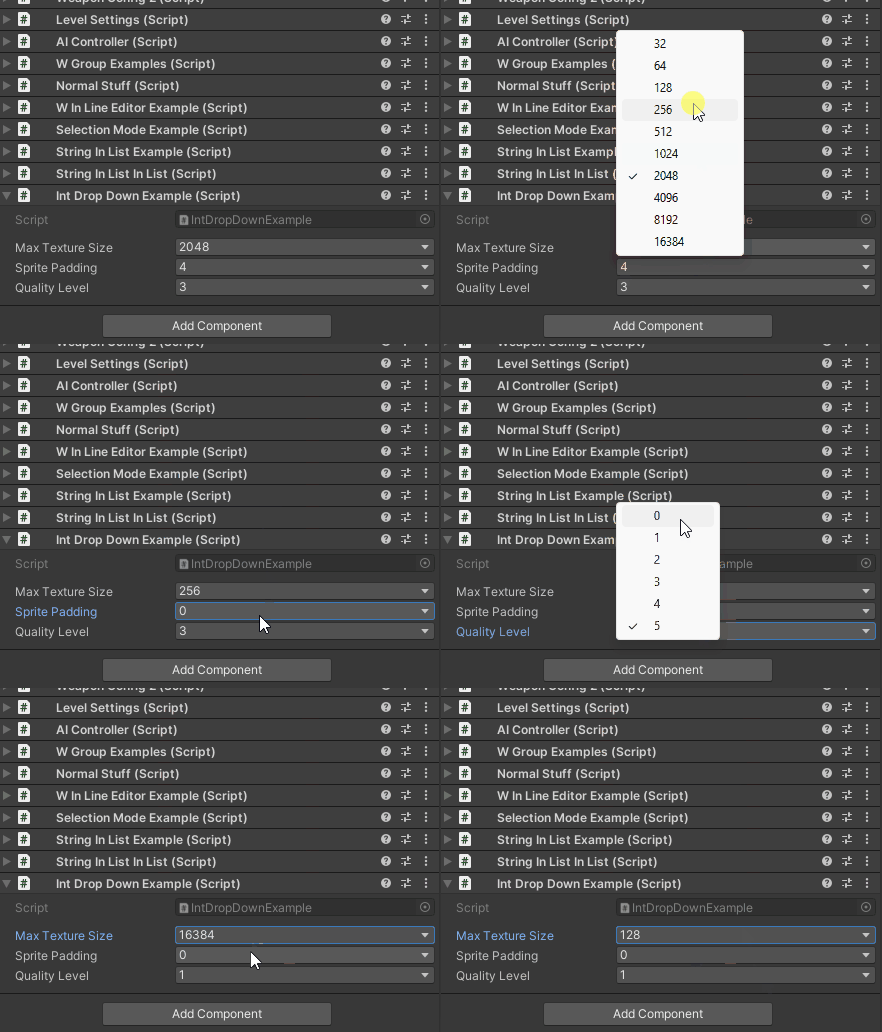
IntDropDown for texture sizes showing power-of-two options
WValueDropDown Property Drawer
Attribute: [WValueDropDown]
Purpose: Generic dropdown for any type with fixed values or provider methods. More flexible than StringInList or IntDropdown — supports all primitive types, custom classes, and dynamic providers.
Syntax:
// Fixed primitive values
[WValueDropDown(0, 25, 50, 100)]
public int staminaThreshold = 50;

[WValueDropDown(0.5f, 1.0f, 1.5f, 2.0f)]
public float damageMultiplier = 1.0f;

[WValueDropDown("Easy", "Normal", "Hard", "Insane")]
public string difficulty = "Normal";

// Static provider method
[WValueDropDown(typeof(PowerUpLibrary), nameof(PowerUpLibrary.GetAvailablePowerUps))]
public PowerUpDefinition selectedPowerUp;

// Instance provider method (context-aware)
[WValueDropDown(nameof(GetAvailableOptions), typeof(string))]
public string selectedOption;
Features:
- All primitive types:
bool,char,byte,sbyte,short,ushort,int,uint,long,ulong,float,double,string - Custom types with
ToString()for labels - Static provider methods from any type
- Instance provider methods for context-aware options
- Type-safe value selection
Best For:
- Type-safe options beyond strings/ints
- Custom class/struct selection
- Dynamic options from runtime data
- Designer-friendly preset selection
Custom Types Example:
using UnityEngine;
using WallstopStudios.UnityHelpers.Core.Attributes;
using System.Collections.Generic;

[System.Serializable]
public class Preset
{
    public string name;
    public float value;

    public override string ToString() => name;  // Used for dropdown label
}

public class Config : MonoBehaviour
{
    [WValueDropDown(typeof(Config), nameof(GetPresets))]
    public Preset selectedPreset;

    public static IEnumerable<Preset> GetPresets()
    {
        return new[]
        {
            new Preset { name = "Low", value = 0.5f },
            new Preset { name = "Medium", value = 1.0f },
            new Preset { name = "High", value = 2.0f },
        };
    }
}
Instance Provider Example:
public class DynamicOptions : MonoBehaviour
{
    public string prefix = "Option";
    public int optionCount = 5;

    [WValueDropDown(nameof(GetAvailableOptions), typeof(string))]
    public string selectedOption;

    private IEnumerable<string> GetAvailableOptions()
    {
        for (int i = 1; i <= optionCount; i++)
        {
            yield return $"{prefix}_{i}";
        }
    }
}
Visual Reference
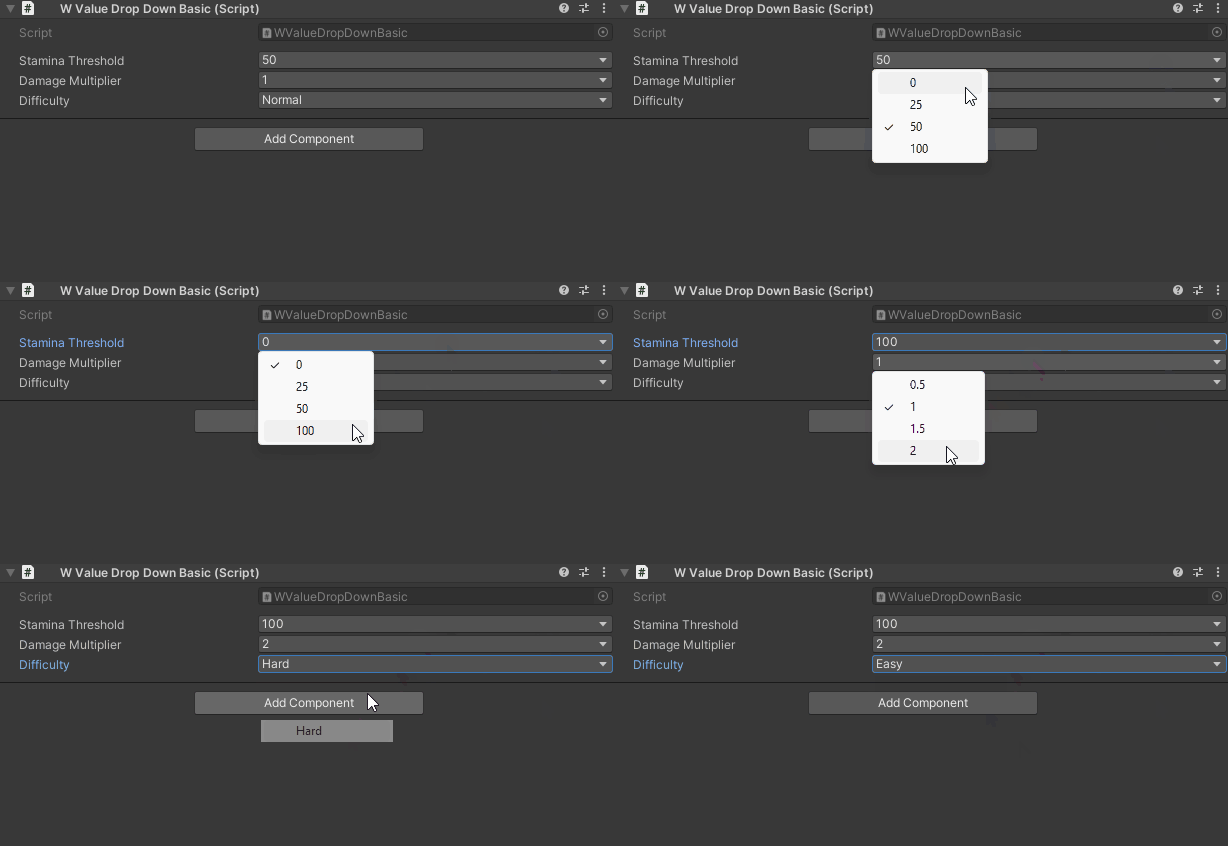
WValueDropDown showing predefined integer, float, and string values
For more detailed documentation, including all constructor forms, see Inspector Selection Attributes.
WReadOnly Property Drawer
Attribute: [WReadOnly]
Purpose: Display fields as read-only in the inspector (grayed out, non-editable).
Syntax:
using WallstopStudios.UnityHelpers.Core.Attributes;

[WReadOnly]
public int calculatedValue;

[WReadOnly]
public string currentState;
Features:
- Disables GUI for field
- Shows value but prevents editing
- Maintains proper height and layout
- Works with all property types
Best For:
- Displaying runtime state
- Showing calculated/derived values
- Debug information in inspector
- Values set by code only
Example:
using UnityEngine;
using WallstopStudios.UnityHelpers.Core.Attributes;

public class WReadOnlyExample : MonoBehaviour
{
    public int baseHealth = 100;
    public int healthBonus = 0;

    [WReadOnly]
    public int totalHealth;

    private void OnValidate()
    {
        totalHealth = baseHealth + healthBonus;
    }
}
Visual Reference
WReadOnly field showing totalHealth as a non-editable calculated value
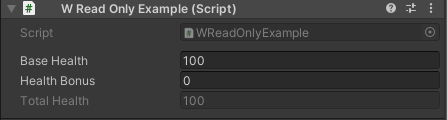
For detailed documentation on validation attributes, see Inspector Validation Attributes.
Automation & Utilities
ScriptableObject Singleton Creator
Type: Automatic (runs on editor load)
Menu: N/A (automatic) - Uses [InitializeOnLoad]
Purpose: Automatically creates and maintains singleton ScriptableObject assets.
See the base API guide for details on ScriptableObjectSingleton<T> usage, scenarios, and Odin compatibility: Singleton Utilities.
How It Works:
1. Runs when Unity editor starts
2. Scans all ScriptableObjectSingleton<T> derived types
3. Creates missing assets in Assets/Resources/
4. Moves misplaced singletons to correct locations
5. Respects [ScriptableSingletonPath] attribute
Usage Example:
using WallstopStudios.UnityHelpers.Utils;
using WallstopStudios.UnityHelpers.Core.Attributes;

// Define singleton:
public class GameSettings : ScriptableObjectSingleton<GameSettings>
{
    public float masterVolume = 1.0f;
    public bool enableVSync = true;
}

// Optional custom path:
[ScriptableSingletonPath("Settings/Audio")]
public class AudioSettings : ScriptableObjectSingleton<AudioSettings>
{
    public float musicVolume = 0.8f;
}

// Assets created automatically:
// - Assets/Resources/GameSettings.asset
// - Assets/Resources/Settings/Audio/AudioSettings.asset

// Access at runtime:
float volume = GameSettings.Instance.masterVolume;
Folder Structure:
Assets/
  Resources/
    GameSettings.asset              (no path attribute)
    Settings/
      Audio/                        ([ScriptableSingletonPath("Settings/Audio")])
        AudioSettings.asset
Best For:
- Managing game settings as unique assets
- Centralizing configuration data
- Ensuring essential ScriptableObjects exist
- Team workflows to prevent missing asset errors
- Automatic project setup for new developers
Customization:
- Set
IncludeTestAssemblies = trueto create test singletons - Call
EnsureSingletonAssets()manually to refresh
Sprite Label Processor
Type: Automatic asset processor
Menu: N/A (automatic) - Uses AssetPostprocessor
Purpose: Automatically maintains a cache of all sprite labels in the project for fast lookup in editor tools.
How It Works:
- Monitors sprite asset imports/reimports (PNG, JPG, JPEG)
- Detects changes to asset labels on sprites
- Updates global sprite label cache automatically
- Provides a cached label list to tools like Sprite Atlas Generator
What Gets Cached:
- All unique asset labels across sprite assets
- Sorted alphabetically for a consistent display
- Updated on import, not at runtime
Performance Benefits:
- ✅ No need to scan the entire project for labels
- ✅ Fast dropdown population in editors
- ✅ Automatic cache invalidation on changes
- ✅ Only processes sprite texture types
Runtime Usage:
using WallstopStudios.UnityHelpers.Core.Helper;

// Access cached sprite labels
string[] labels = SpriteLabelCache.GetAllLabels();
Request Script Recompilation
Menu: Tools > Wallstop Studios > Unity Helpers > Request Script Recompilation
Shortcut: Ctrl/Cmd + Alt + R (configurable in Unity’s Shortcut Manager)
Purpose: Manually trigger Unity script recompilation without needing to modify files or restart the editor.
Visual Reference
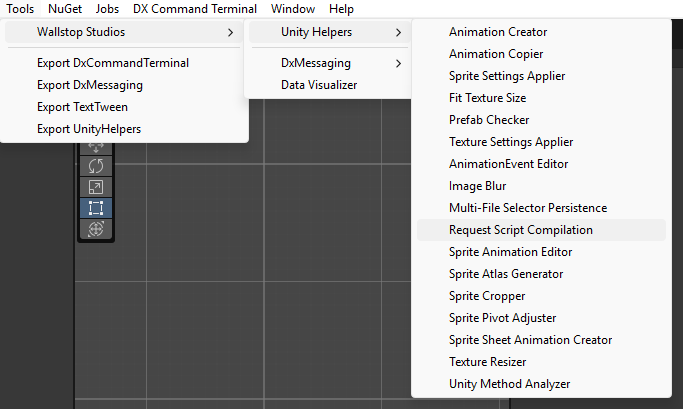
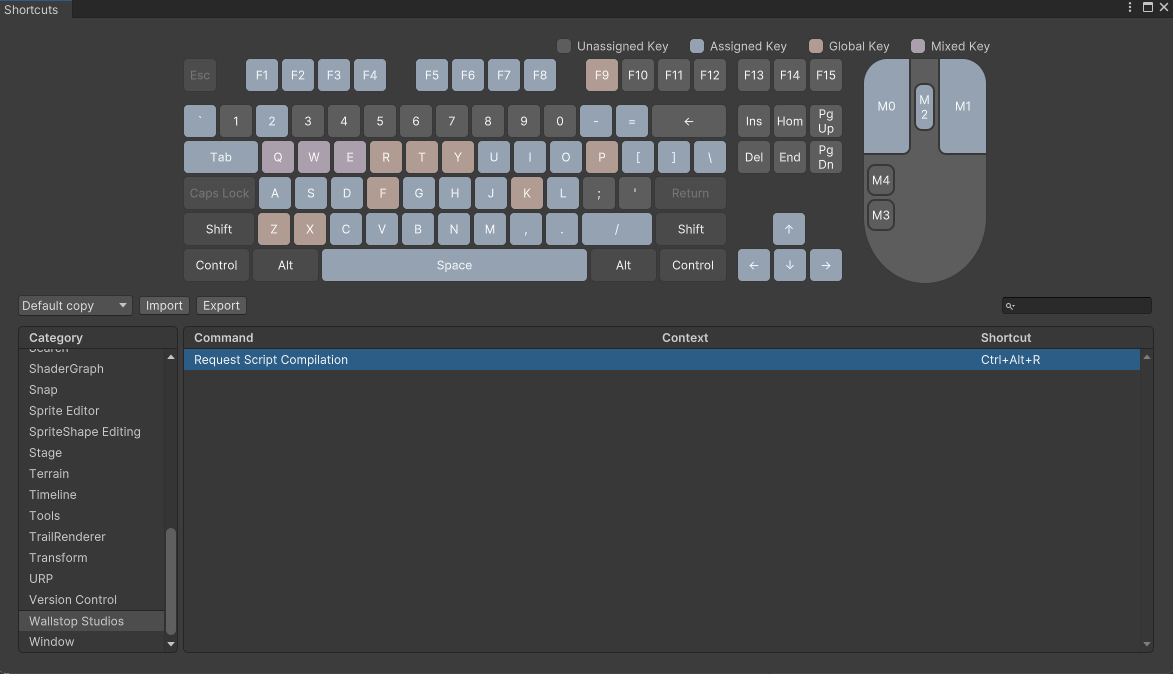
Key Features:
- One-click script recompilation
- Customizable keyboard shortcut (default: Ctrl/Cmd + Alt + R)
- Useful after external code generation or build processes
- Available in Unity’s Shortcut Manager under “Wallstop Studios / Request Script Compilation”
When to Use:
- After external code generation tools modify scripts
- When Unity doesn’t auto-detect file changes
- To force recompilation without touching files
- In automated workflows that need explicit compilation steps
Common Workflow:
1. Run external code generator
2. Press Ctrl+Alt+R (or use menu item)
3. Wait for Unity to recompile scripts
4. Continue working with updated code
Project Settings: Unity Helpers
Menu: Edit > Project Settings > Wallstop Studios > Unity Helpers
Purpose: Centralized configuration for Unity Helpers features, including buffer settings, pagination defaults, and inspector behavior.
Visual Reference
Centralized configuration panel in Unity’s Project Settings
Key Settings:
Coroutine Wait Buffer Defaults
Configure default behavior for WaitForSeconds, WaitForFixedUpdate, and other yield instructions:
// Settings affect runtime buffer pool behavior:
- Quantization: How yield times are rounded (e.g., 0.1f rounds to nearest 0.1)
- Entry Caps: Maximum number of cached wait instructions per type
- LRU Mode: Least-recently-used eviction when caps are exceeded
Impact:
- Reduces GC allocations from repeated coroutine yields
- Settings apply automatically on domain reload and player start
- Can be overridden at runtime if needed
Generated Asset: Resources/WallstopStudios/UnityHelpers/UnityHelpersBufferSettings.asset
Inspector Pagination Defaults
StringInListPageSize: Default page size for StringInList dropdowns (default: 50)WEnumToggleButtonsPageSize: Default page size for enum toggle button grids (default: 20)- Per-attribute overrides available on individual fields
When to Adjust:
- Large option lists feel cramped (increase page size)
- Inspector feels sluggish with many options (decrease page size)
- Project-wide consistency for dropdown/toggle experiences
Runtime Usage:
using WallstopStudios.UnityHelpers.Core.Helper;

// Get all known sprite labels
string[] allLabels = Helpers.GetAllSpriteLabelNames();

// Used internally by StringInList attribute
[StringInList(typeof(Helpers), nameof(Helpers.GetAllSpriteLabelNames))]
public List<string> selectedLabels;
Cache Updates:
- On sprite import/reimport
- When labels added/removed from sprites
- After asset database refresh
- Automatically during asset post-processing
Best For:
- Tools requiring sprite label selection
- DropDown menus for label filtering
- Maintaining label consistency across the project
- Fast label-based sprite queries
Technical Notes:
- Skips execution in batch mode and CI environments
- Uses efficient HashSet for uniqueness checks
- Sorted results for a consistent UI display
- Thread-safe cache updates
Attribute Metadata Cache Generator
Type: Automatic (runs on editor load and domain reload)
Purpose: Pre-generate attribute system metadata at edit time to eliminate runtime reflection overhead. The cache is automatically regenerated when scripts change. You can manually refresh it via the “Purge & Refresh Cache” button in the AttributeMetadataCache asset inspector.
What Gets Cached:
- All “Attribute” fields across AttributesComponent types
- Relational metadata ([ParentComponent], [ChildComponent], [SiblingComponent])
- Assembly-qualified type names for runtime resolution
- Field types (single, array, List, HashSet)
- Interface detection for polymorphic queries
Performance Benefits:
- ✅ Eliminates reflection overhead during attribute initialization
- ✅ Reduces first-frame lag when attribute components awake
- ✅ Enables fast attribute name lookups for UI
- ✅ Optimizes relational component queries
- ✅ Supports IL2CPP ahead-of-time compilation
Runtime Usage:
// Cache is loaded automatically:
AttributeMetadataCache cache = AttributeMetadataCache.Instance;

// Get all known attribute names:
string[] allAttributes = cache.AllAttributeNames;

// Check type for attribute fields:
TypeFieldMetadata metadata = cache.GetMetadataForType(typeof(MyAttributesComponent));
if (metadata != null)
{
    foreach (string fieldName in metadata.AttributeFieldNames)
    {
        Debug.Log($"Found attribute field: {fieldName}");
    }
}

// Query relational component metadata:
RelationalTypeMetadata relational = cache.GetRelationalMetadataForType(typeof(MyComponent));
Cache Regenerates:
- On Unity editor startup (automatic)
- After script recompilation (automatic)
- Manual trigger via menu item
- After domain reload in the editor
Best For:
- Large projects with many attribute-based components
- Games using extensive parent/child relationships
- Optimizing startup time for complex prefabs
- IL2CPP builds where reflection is expensive
- Tools that need to enumerate available attributes
Editor Utilities
Type: Static utility class
Namespace: WallstopStudios.UnityHelpers.Editor.Utils
Purpose: Helper methods for Unity Editor operations.
Available Methods:
GetCurrentPathOfProjectWindow()
Gets the currently selected folder in Unity’s Project window.
// In an editor window or wizard:
string currentFolder = EditorUtilities.GetCurrentPathOfProjectWindow();
if (!string.IsNullOrEmpty(currentFolder))
{
    string newAssetPath = $"{currentFolder}/NewGeneratedAsset.asset";
    AssetDatabase.CreateAsset(myAsset, newAssetPath);
}
else
{
    // Fallback to default location
    AssetDatabase.CreateAsset(myAsset, "Assets/NewGeneratedAsset.asset");
}
Returns: Asset-relative path (e.g., “Assets/Scripts/Editor”) or empty string.
Use Cases:
- Asset creation wizards defaulting to the selected folder
- Context menu extensions operating on the current location
- Batch processing tools respecting working directory
Technical Notes:
- Uses reflection to access internal Unity API
- May break in future Unity versions
- Returns empty string on failure (no exceptions)
Best For:
- Context-aware asset creation
- User-friendly editor tools
- Respecting the current working directory
Quick Reference
Tools by Category
Image Processing:
- Image Blur Tool - Gaussian blur effects
- Sprite Cropper - Remove transparent padding
- Texture Settings Applier - Batch import settings
- Sprite Settings Applier - Sprite-specific settings
- Sprite Pivot Adjuster - Pivot point adjustment
- Texture Resizer - Resize textures with bilinear/point algorithms
- Fit Texture Size - Auto-fit texture max size to source dimensions
Animation:
- Sprite Animation Editor - Visual animation editing with preview
- Animation Event Editor - Visual animation event editing with sprite preview
- Animation Creator - Bulk-create clips from naming patterns
- Animation Copier - Duplicate and manage clips
- Sprite Sheet Animation Creator - Convert atlases to clips
Sprite Atlases:
- Sprite Atlas Generator - Regex/label-based atlas creation and packing
Quality & Validation:
- Prefab Checker - Comprehensive prefab validation
Custom Editors:
- MatchColliderToSprite Editor - Manual collider matching
- PolygonCollider2DOptimizer Editor - Collider simplification
- EnhancedImage Editor - HDR color and shape mask support
Property Drawers:
- WShowIf - Conditional field visibility
- StringInList - DropDown selection for strings
- IntDropDown - DropDown selection for integers
- WReadOnly - Read-only inspector fields
Automation:
- ScriptableObject Singleton Creator - Auto-create singletons
- Attribute Metadata Cache Generator - Performance optimization
- Sprite Label Processor - Automatic sprite label caching
Utilities:
- Editor Utilities - Helper methods for editor scripting
All Menu Items
Tools > Wallstop Studios > Unity Helpers:
- Animation Copier
- Animation Creator
- AnimationEvent Editor
- Fit Texture Size
- Image Blur
- Prefab Checker
- Sprite Animation Editor
- Sprite Atlas Generator
- Sprite Cropper
- Sprite Pivot Adjuster
- Sprite Settings Applier
- Sprite Sheet Animation Creator
- Texture Resizer
- Texture Settings Applier
Assets > Create > Wallstop Studios > Unity Helpers:
- Scriptable Sprite Atlas Config
Common Workflows
Setting Up New Sprites
1. Import sprites to Assets/Sprites/
2. Use Sprite Cropper to remove padding
3. Use Texture Settings Applier:
   - Filter Mode: Bilinear
   - Wrap Mode: Clamp
   - Compression: CompressedHQ
4. Use Sprite Settings Applier:
   - Set consistent PPU (e.g., 32 or 64)
5. Use Sprite Pivot Adjuster for consistent alignment
Creating and Editing Animations
1. Prepare sprite frames in folder
2. Open Sprite Animation Editor
3. Click "Browse Clips (Multi)..." if clips exist, or
4. Use Animation Creator to generate from sprites
5. Edit in Sprite Animation Editor:
   - Adjust frame order via drag-drop
   - Set appropriate FPS
6. Save clips
7. (Optional) Add animation events:
   a. Open AnimationEvent Editor
   b. Drag Animator to "Animator Object" field
   c. Select animation clip
   d. Add events at specific frames
   e. Configure event methods and parameters
   f. Save changes
Creating Sprite Atlases
1. Create atlas config:
   a. Open Sprite Atlas Generator
   b. Click "Create New Config in 'Assets/Data'"
   c. Name your atlas configuration
2. Configure source folders:
   a. Click "Add New Source Folder Entry"
   b. Select folder containing sprites
   c. Add regex patterns (e.g., "^character_.*")
   d. Or add labels for filtering
3. Set packing options:
   - Max texture size (2048 recommended)
   - Padding (4px default)
   - Compression settings
4. Preview changes:
   a. Click "Scan Folders"
   b. Review sprites to add/remove
5. Generate atlas:
   a. Click "Add X Sprites" if satisfied
   b. Click "Generate/Update .spriteatlas ONLY"
   c. Click "Pack All Generated Sprite Atlases"
Pre-Commit Validation
1. Open Prefab Checker
2. Enable all critical checks:
   - Missing Scripts ✓
   - Missing Required Components ✓
   - Null Object References ✓
3. Add changed prefab folders
4. Click "Run Checks"
5. Fix all reported issues
6. Re-run to verify
7. Commit changes
Optimizing Textures for Build
1. Use Sprite Cropper on all sprites (reduces memory)
2. Use Texture Settings Applier with:
   - Appropriate compression for platform
   - Crunch compression enabled
   - Proper max texture sizes
3. Review build report for texture memory usage
4. Iterate on settings as needed
Keyboard Shortcuts & Tips
Sprite Animation Editor:
Enterin frame order field: Apply frame reordering- Drag frames: Reorder via visual feedback
- Drag clips: Reorder layer priority
Prefab Checker:
- Click console errors: Selects problematic prefabs
- Toggle checks: Right-aligned checkboxes
General:
- All tools remember last used directories
- Most tools support drag-and-drop folders
- Batch operations show progress in the console
Performance Considerations
Sprite Cropper:
- Uses parallel processing for pixel scanning
- Can process hundreds of sprites quickly
- Memory usage scales with sprite size
Texture Settings Applier:
- Triggers Unity reimport for affected textures
- May take time on large texture sets
- Refresh only happens once after all changes
Prefab Checker:
- Caches reflection metadata for speed
- Fast on repeated runs
- Scales linearly with prefab count
Attribute Metadata Cache:
- Eliminates ~95% of runtime reflection overhead
- Startup time improvement: 50-200ms on large projects
- Critical for IL2CPP builds
Troubleshooting
Tool window won’t open:
- Check the console for errors
- Verify that the package is in the correct location
- Try reimporting package
Settings not applying:
- Ensure textures aren’t in use
- Check the console for import errors
- Verify file permissions
Cache not regenerating:
- Manually trigger via menu
- Check for script compilation errors
- Verify ScriptableObject singleton exists
Prefab Checker missing issues:
- Ensure all relevant checks are enabled
- Verify folders are correct
- Check filter settings
Best Practices
Organization:
- Keep sprites in an organized folder structure
- Use consistent naming conventions
- Separate by type (UI, Characters, Environment)
Performance:
- Run Sprite Cropper before creating atlases
- Use appropriate texture compression
- Enable crunch compression for mobile
Quality:
- Run Prefab Checker before commits
- Use [ValidateAssignment] on critical fields
- Maintain consistent texture settings per category
- Use the manual recompilation menu/shortcut when iterating on packages to avoid reopening the project
Workflow:
- Batch similar operations together
- Use multi-file selection where available
- Leverage automation tools (SingletonCreator, CacheGenerator)
Compilation helpers:
- Menu path:
Tools > Wallstop Studios > Unity Helpers > Request Script Compilation - Shortcut:
Ctrl/Cmd + Alt + R(configurable via Unity’s Shortcut Manager under Wallstop / Request Script Compilation) - Behavior: Forces an
AssetDatabase.Refresh(synchronous import) before callingCompilationPipeline.RequestScriptCompilation()and logs whenever Unity is already compiling so scripts created outside the editor are imported immediately.
Additional Resources
Attributes System:
- See
[ValidateAssignment]for prefab validation - See
[ScriptableSingletonPath]for custom singleton paths - See
[ParentComponent],[ChildComponent],[SiblingComponent]for relational queries
Related Components:
ScriptableObjectSingleton<T>- Base class for settingsAttributesComponent- Base class for the attribute systemLayeredImage- UI Toolkit multi-layer sprite rendering
Version Information
Document Version: 2.0 Package: com.wallstop-studios.unity-helpers Last Updated: 2025-10-08
What’s New in v2.0:
- Added comprehensive Sprite Atlas Generator documentation
- Added Animation Event Editor documentation
- Added Texture Resizer and Fit Texture Size tools
- Added Custom Component Editors section
- Added Property Drawers & Attributes section
- Added Sprite Label Processor documentation
- Expanded all existing tool documentation
- Added new workflow examples
- Complete menu item reference
- Enhanced quick reference section
Summary
This package provides 20+ editor tools across multiple categories:
14 Editor Windows/Wizards:
- Image Blur Tool, Sprite Cropper, Texture Settings Applier, Sprite Settings Applier
- Sprite Pivot Adjuster, Texture Resizer, Fit Texture Size
- Sprite Animation Editor, Animation Event Editor, Animation Creator, Animation Copier
- Sprite Sheet Animation Creator, Sprite Atlas Generator, Prefab Checker
3 Custom Component Editors:
- MatchColliderToSprite, PolygonCollider2DOptimizer, EnhancedImage
4 Property Drawers:
- WShowIf, StringInList, IntDropDown, WReadOnly
3 Automated Systems:
- ScriptableObject Singleton Creator
- Attribute Metadata Cache Generator
- Sprite Label Processor
1 Utility Library:
- Editor Utilities
All tools are designed to work together seamlessly and follow consistent design patterns for ease of use.
For questions, issues, or feature requests, please contact the Wallstop Studios team.
- Integration note: The cache powers editor dropdowns and reflection shortcuts for the Effects system’s
AttributeModification.attributefield. See Effects System for how attributes, effects, and tags fit together.
MultiFile Selector (UI Toolkit)
- The
MultiFileSelectorElementis primarily intended for Editor tooling. It can also be used in player builds, where it enumerates files under the application’s data root. In the Editor it integrates withEditorPrefsand Reveal-in-Finder; at runtime it falls back toPlayerPrefsand omits Editor-only affordances.